DM Plant Manufacturers in Pune | Shree Water Tech
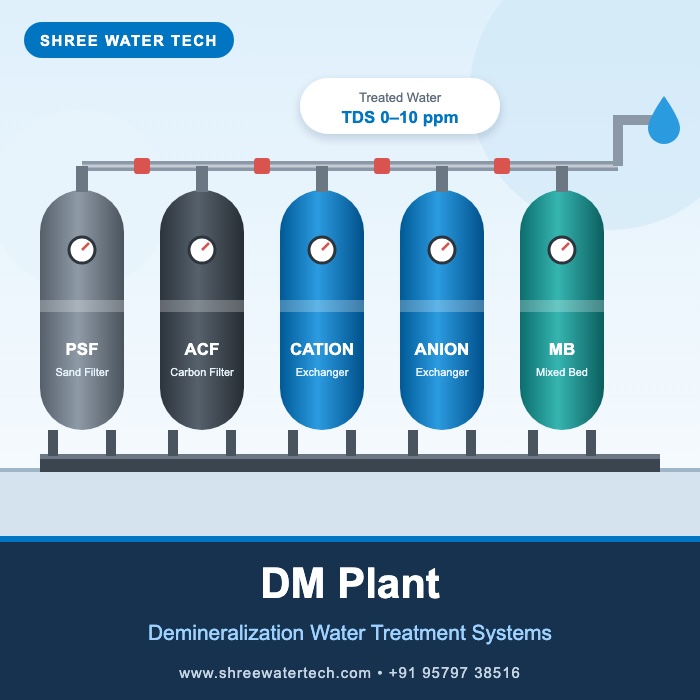


Shree Water Tech is well-known DM Plant Manufacturers, Suppliers and Exporters in Pune, Maharashtra. We design and deliver advanced Demineralized water treatment plant systems tailored to the specific needs of industrial and commercial sectors.
Our Industrial DM plant solutions use proven ion exchange technology to deliver consistent demineralized water quality for various applications. We combine skilled engineering, carefully selected components and customized system designs to provide reliable performance at cost-effective prices.
From selecting the right plant capacity to installation, commissioning and after-sales assistance, we ensure complete project support with a strong focus on quality, efficiency and customer satisfaction.
What Is a DM Plant and How Does It Work for Industrial Water Purification?
A DM plant (Demineralization Plant) is a specialized water treatment system that removes dissolved mineral salts and ionic impurities through an ion exchange process. It produces demineralized water with low ionic content, making it suitable for applications that require controlled water quality. An Industrial deionized water plant is widely used in manufacturing, pharmaceuticals and power generation, while an RO based DM plant can provide additional pretreatment to improve overall purification efficiency.
Step-by-Step Working Principle of a DM Plant
A DM water purification system operates on the ion exchange principle, where dissolved minerals and unwanted ionic impurities are removed using specially selected resin materials. The complete treatment process involves the following stages:
- Raw Water Feeding: Raw water is supplied to the treatment unit through a feed pump, which maintains the required flow and pressure for smooth plant operation.
- Pre-Treatment Process: Water passes through filtration equipment to remove suspended particles, chlorine and other impurities that may affect resin efficiency. In a DM plant with RO pretreatment, reverse osmosis is also used to reduce the dissolved salt load before ion exchange.
- Cation Exchange Process: Water enters the cation exchange vessel, where positively charged ions such as calcium, magnesium and sodium are replaced with hydrogen ions, reducing mineral content.
- Anion Exchange Process: The partially treated water moves into the anion vessel, where negatively charged ions such as chlorides, sulphates and bicarbonates are exchanged with hydroxide ions.
- Demineralization Process: The released hydrogen and hydroxide ions combine to form water, significantly reducing dissolved ionic impurities and producing demineralized water.
- Mixed Bed Polishing: For applications requiring higher purity, water passes through a Mixed bed DM plant vessel containing both cation and anion resins to remove the remaining traces of dissolved ions.
- Water Quality Monitoring: The treated water is tested using conductivity or resistivity meters to check its purity and ensure that it meets the required application standards.
- Water Storage and Distribution: The purified water is collected in a suitable storage tank and supplied to industrial or commercial processes according to their water requirements.
- Resin Regeneration: When the ion exchange resins become exhausted, they are regenerated using suitable acid and alkali chemicals to restore their treatment capacity for the next operating cycle. A DM plant with automatic regeneration can manage this process through automated controls, reducing manual intervention.
Types of DM Plants
As DM Plant Manufacturers in Pune, Maharashtra, we offer a wide range of demineralization systems designed to meet different industrial water purification needs, treatment capacities and operational requirements, including customized Commercial DM plant solutions.
Two-Bed DM Plant
This system uses separate cation and anion exchange vessels to remove positively and negatively charged dissolved ions from water. It is commonly used for boiler feed water treatment and general industrial applications.
Mixed-Bed DM Plant
It combines cation and anion exchange resins in a single vessel to provide an additional purification stage. This configuration is suitable for applications requiring very low conductivity and high-purity water, including pharmaceutical manufacturing and power generation. A High purity DM water plant is particularly suitable for such demanding applications.
Multi-Stage DM Plant
This configuration incorporates additional treatment stages, such as degasser towers and extra ion exchange vessels, to improve purification efficiency. A Three bed DM plant is one such configuration that is particularly useful for high-TDS water and applications where optimized regeneration chemical consumption is important.
Mini or Packaged DM Plant
Designed for laboratories, small industries and commercial facilities, this system offers effective water purification in a space-saving arrangement. Its packaged construction makes installation and operation convenient for lower water treatment requirements.
Industrial DM Plant
Built to handle larger water treatment demands, this system supports continuous operations across various manufacturing sectors. A High capacity DM plant is widely used in power plants, refineries, chemical industries and large production facilities.
Automatic DM Plant
Equipped with automated valves and control arrangements, this system manages treatment cycles and resin regeneration with minimal manual intervention. A Fully automatic DM plant helps simplify operations and maintain consistent water treatment performance.
Semi-Automatic DM Plant
This configuration combines automated operating functions with manually controlled activities for greater operational flexibility. It is suitable for facilities that prefer partial automation with operator supervision.
Manual DM Plant
Operated through manually controlled valves, this system allows operators to manage water flow, treatment stages and resin regeneration. It offers a straightforward and economical option for smaller installations with regular operator availability.
RO-Based DM Plant
By combining reverse osmosis with ion exchange technology, this arrangement reduces dissolved salts before water enters the demineralization stage. It helps reduce the load on exchange resins and can lower regeneration frequency and chemical consumption.
Skid-Mounted DM Plant
Major treatment components, vessels and piping are assembled on a common supporting frame for easy transportation and installation. This arrangement is suitable for industrial sites that require a compact and organized treatment setup.
Main Components of a DM Plant
A properly designed demineralization system consists of several interconnected components that work together to deliver the required water quality.
- Raw Water Storage Tank: Stores incoming water and ensures a continuous supply to the treatment system.
- Feed Water Pump: Transfers raw water through the treatment stages at the required operating pressure.
- Pressure Sand Filter (PSF): Removes suspended solids, dirt and other physical impurities from incoming water.
- Activated Carbon Filter (ACF): Reduces chlorine, organic matter, odour and other contaminants that can affect resin performance.
- Cation Exchange Vessel: Removes positively charged dissolved minerals through the ion exchange process.
- Anion Exchange Vessel: Eliminates negatively charged ions to further reduce dissolved mineral content.
- Mixed Bed Vessel: Provides additional polishing to achieve higher levels of water purity.
- Chemical Dosing System: Supplies regeneration chemicals in controlled quantities during the resin regeneration cycle.
- Control Panel: Manages pumps, valves, operating sequences and safety functions according to the selected automation level.
- Storage Tank: Collects treated water for further distribution and industrial use.
- Conductivity Meter: Monitors the ionic quality of treated water and helps operators assess plant performance.
Technical Specifications of a DM Plant
As DM Plant Suppliers in Pune, Maharashtra, we provide customized technical configurations with suitable treatment capacities, filtration arrangements and automation options based on raw water quality and specific application requirements.
| Technical Parameter | Specifications / Details |
|---|---|
| Treatment Technology | Ion Exchange Process |
| Resin Configuration | Strong Acid Cation (SAC) and Strong Base Anion (SBA) |
| Additional Purification | Optional Mixed Bed Polishing |
| Plant Capacity | 50–80 LPH for mini units; 250–5,000 LPH for standard industrial configurations |
| Higher Treatment Capacity | Custom-designed systems for large industrial and power plant requirements |
| Raw Water TDS | Typically up to 1,000–1,200 ppm, depending on water analysis |
| Treated Water TDS | Approximately 0–10 ppm for standard two-bed systems |
| Output Conductivity | Below 10 µS/cm for standard two-bed systems |
| High-Purity Water Quality | Below 1 ppm TDS and up to 1 µS/cm with suitable mixed bed polishing |
| Silica Removal | Approximately 0.01–0.05 ppm with suitable mixed bed configuration |
| Output Water pH | Typically around 6.5–7.5, depending on feedwater and operating conditions |
| Operating Pressure | Approximately 2.5–4.0 kg/cm² |
| Operating Temperature | Approximately 5°C–45°C |
| Pretreatment System | Pressure Sand Filter (PSF), Multi-Grade Filter (MGF) and Activated Carbon Filter (ACF), as required |
| Cation Exchange Resin | Strong Acid Cation (SAC) Resin |
| Anion Exchange Resin | Strong Base Anion (SBA) Resin |
| Degasser System | Optional Degasser Tower for Carbon Dioxide Removal |
| Regeneration System | Acid and Alkali Chemical Regeneration |
| Regeneration Chemicals | Hydrochloric Acid (HCl) and Sodium Hydroxide (NaOH), as selected for the design |
| Pressure Vessel Material | FRP, MSRL, Epoxy-Lined MS or Stainless Steel |
| Instrumentation | Pressure Gauges, Flow Meters, Level Controls and Conductivity Meters |
| Control System | Manual, Semi-Automatic or PLC-Based Automatic Control |
| Installation Type | Floor-Mounted, Packaged or Skid-Mounted |
| Application Areas | Power Plants, Pharmaceuticals, Chemical Manufacturing, Textile and General Industries |
Key Features of a DM Plant
As DM Plant Exporters in Pune, Maharashtra, we focus on delivering technically advanced DM plants with reliable components, flexible operating options and efficient purification capabilities to meet diverse customer requirements.
- Efficient Ion Exchange Technology: Uses specialized cation and anion resins to remove dissolved mineral salts and produce quality demineralized water for industrial applications.
- Customized Treatment Capacity: Available in different capacities, including 500 LPH and 1000 LPH configurations, to accommodate varying industrial and commercial water requirements.
- Flexible Automation Options: Supports manual, semi-automatic and fully automatic operations to simplify plant management and control regeneration cycles.
- Advanced Water Purification: Can incorporate RO pretreatment and mixed bed polishing to achieve the required water purity for demanding industrial processes.
- Durable Construction and Components: Uses suitable pressure vessels, quality resin materials, reliable pumps and corrosion-resistant piping for dependable long-term operation.
Benefits of Installing a DM Plant
As DM Plant Manufacturers in Pune, Maharashtra, we design solutions that help industries maintain the required water quality, minimize mineral-related equipment problems and improve overall water treatment efficiency.
- Reduces Scaling and Mineral Deposits: Removes dissolved calcium, magnesium and other mineral salts that can contribute to scaling in boilers, heat exchangers and industrial pipelines.
- Improves Equipment Performance: Provides low-mineral-content water that helps reduce deposit-related problems and supports the efficient functioning of industrial machinery.
- Maintains Consistent Water Quality: Delivers controlled demineralized water suitable for manufacturing processes that require reduced ionic impurities.
- Optimizes Operating Costs: Suitable pretreatment and efficient resin regeneration can help reduce chemical consumption, maintenance requirements and overall water treatment expenses.
- Supports Multiple Industrial Requirements: Offers flexible treatment configurations that can be selected according to different water consumption levels, process conditions and purity requirements. A DM plant with mixed bed polishing can also be selected for applications requiring higher water purity.
Applications of a DM Plant
As DM Plant Suppliers in Pune, Maharashtra, we provide application-oriented water purification solutions to support industries that require consistent demineralized water for manufacturing, processing and specialized operational activities.
- Power Generation Industry: A Boiler feed water DM plant supplies demineralized water for steam generation and helps minimize scaling and mineral deposits in boilers.
- Pharmaceutical Industry: A Pharmaceutical DM water plant provides treated water for manufacturing processes that require controlled ionic purity in accordance with applicable water quality standards.
- Chemical Processing Industry: Supports chemical preparation, dilution and production activities by supplying water with reduced dissolved mineral content.
- Textile Industry: Provides suitable process water for dyeing, washing and finishing operations where dissolved minerals can affect fabric quality and colour consistency.
- Food Processing Industry: Supplies demineralized water for selected food production, equipment cleaning and processing applications according to specific product requirements.
- Automobile and Engineering Industry: Provides treated water for component cleaning, surface treatment, manufacturing and other industrial operations requiring low-mineral-content water.
- Electronics and Electrical Industry: Supports selected component manufacturing and equipment processes that require high-purity water with controlled ionic contamination.
- Laboratories and Research Facilities: Supplies demineralized water for laboratory preparation, analytical procedures and other applications requiring reduced dissolved impurities.
Why Choose Us?
- Application-Based Engineering: We evaluate raw water quality, treatment capacity and end-use requirements to recommend a suitable demineralization system for each project.
- Quality-Focused Manufacturing: We emphasize suitable materials, dependable components and practical plant configurations to deliver reliable water treatment solutions at competitive prices.
- End-to-End Project Assistance: We support customers through technical consultation, system design, installation, commissioning and after-sales service for a smoother project experience.
Shree Water Tech is prominent DM Plant Manufacturers, Suppliers and Exporters in Pune, Maharashtra. We are committed to providing dependable DM plant solutions for diverse industrial and commercial applications. With customized designs, quality-focused engineering and competitive pricing, we aim to deliver efficient water purification systems that meet customer requirements and support consistent performance over the long term. Connect with us for further details.
FAQ’s
A DM plant removes dissolved mineral salts and ionic impurities from water through ion exchange technology. Its main purpose is to supply demineralized water for industrial and commercial applications requiring controlled water quality.
An RO plant removes dissolved impurities using a semi-permeable membrane, whereas a DM plant uses ion exchange resins to remove dissolved ions. Both technologies can be combined to achieve effective water purification and higher output quality.
Industrial DM plants are available in different capacities, ranging from small LPH units to large systems designed for continuous industrial operations. The required capacity depends on daily water consumption, raw water quality and production requirements.
A standard two-bed system can typically produce water with approximately 0–10 ppm TDS under suitable operating conditions. Additional mixed-bed polishing can achieve even lower dissolved ionic levels depending on the system design.
Resin regeneration frequency depends on raw water TDS, treatment capacity, daily consumption and resin condition. Regular water quality monitoring helps determine the appropriate regeneration cycle.
The cost depends on treatment capacity, raw water quality, resin quantity, vessel material, automation level and required water purity. A customized quotation can be prepared after evaluating the project's technical requirements.