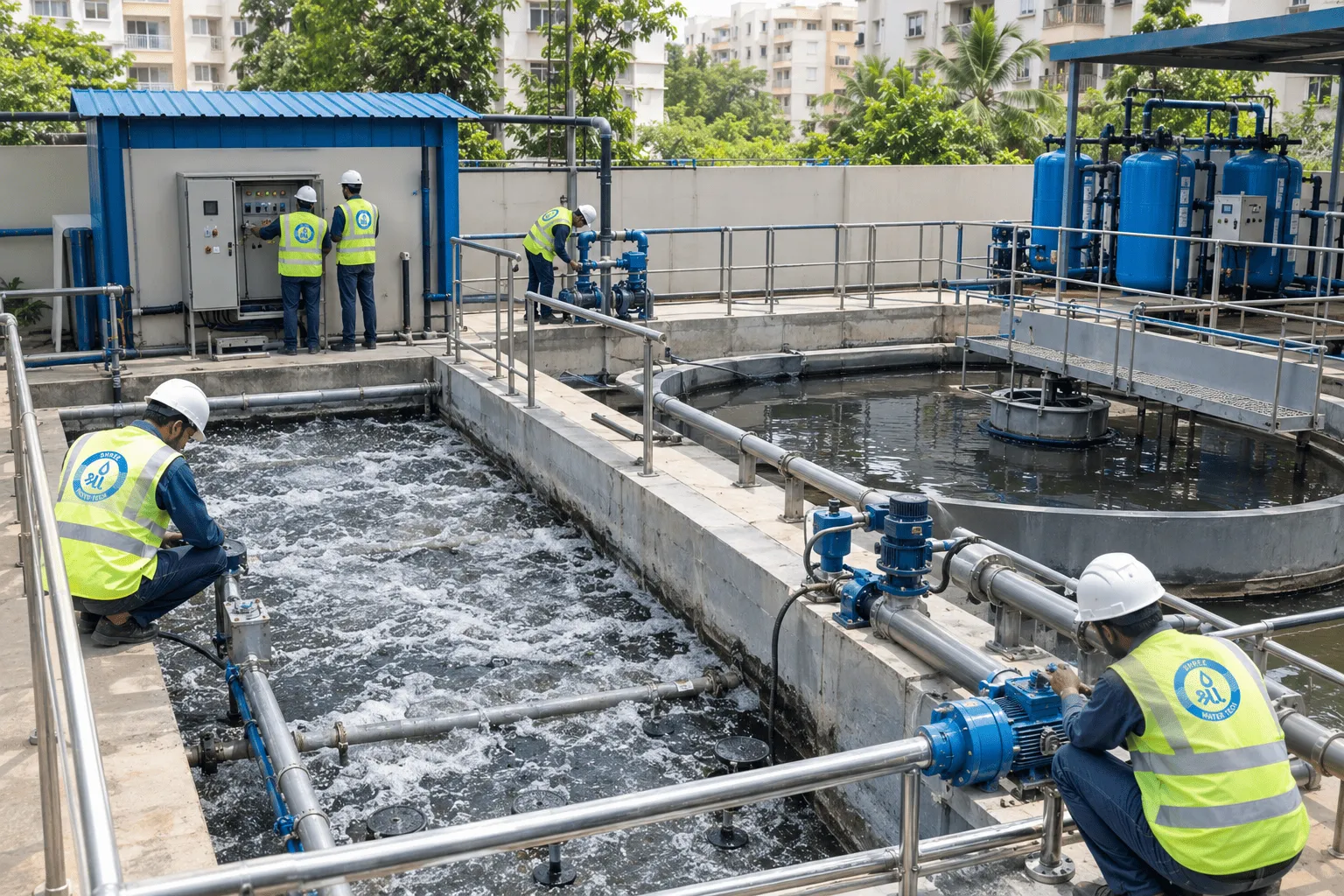
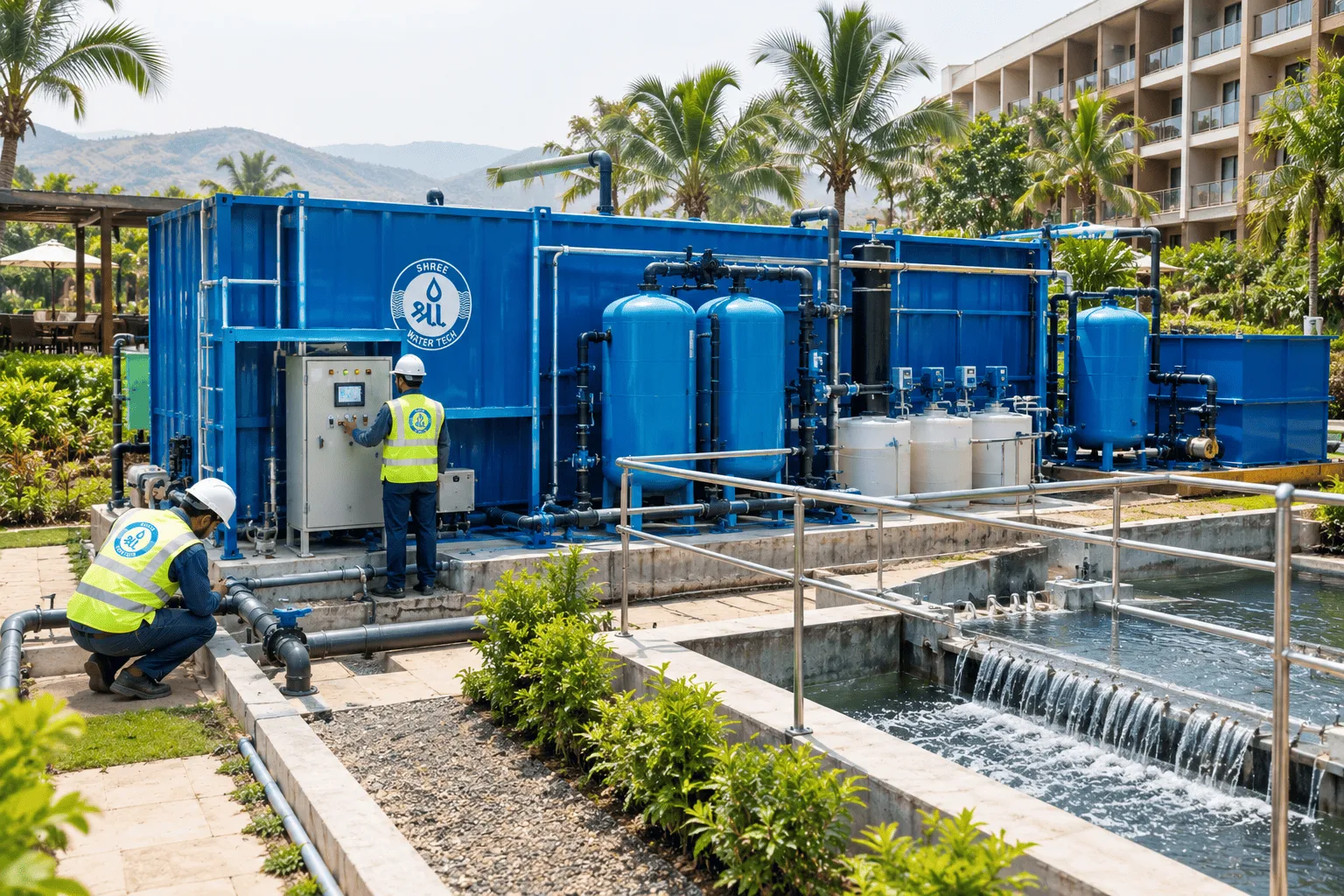
Top 10 Sewage Treatment Plant (STP) Manufacturers in Pune | Shree Water Tech
Established in 2014, Shree Water Tech is a trusted provider of Sewage Treatment Plant (STP) Manufacturers, Suppliers and Exporters in Pune, delivering wastewater treatment solutions for residential, commercial, institutional, municipal, and industrial applications. With more than 150 installations across India, we bring practical experience in designing and implementing treatment systems based on project requirements, wastewater characteristics, site conditions, and water reuse objectives.
Effective sewage treatment is essential for maintaining hygiene, reducing environmental pollution, and protecting valuable water resources. Our STP plants in Pune are designed to treat wastewater through suitable treatment processes such as MBBR, SBR, MBR and activated sludge, helping apartments, housing societies, hotels, hospitals, factories and commercial buildings manage sewage responsibly and reuse treated water for approved non-potable applications such as gardening, flushing, and other suitable purposes, subject to the required treatment quality.
From system selection and design to installation and commissioning, Shree Water Tech focuses on providing sewage treatment solutions that meet the specific operational and treatment needs of each project. We serve customers across Pune, Pimpri-Chinchwad, Wakad, Hinjewadi, Baner, Kharadi and Hadapsar, and our experience across India supports our commitment to practical wastewater management and sustainable water conservation.
Leading Top 10 Sewage Treatment Plant Manufacturers in Pune
Pune has several companies offering Sewage Treatment Plants (STPs) for
residential, commercial, industrial, institutional, hospitality, and infrastructure
applications. The following list highlights prominent companies associated with STP and
wastewater treatment solutions in Pune. The order is presented for editorial comparison
and should not be considered an independent industry ranking.
Rank
Company
STP / Wastewater Expertise
1
Shree Water Tech
Featured STP Manufacturer in Pune offering design,
engineering, installation, commissioning, and technical support for
sewage treatment systems. Established in 2014, Shree Water Tech has
completed 150+ installations across India and provides
application-specific STP solutions for residential, commercial,
institutional, and industrial requirements. Its STP expertise includes
MBBR, SBR, MBR, ASP, FAB, packaged, prefab, modular,
containerized, decentralized, and tertiary treatment
systems.
2
Envocare Projects & Services
Provides sewage and wastewater treatment solutions for residential,
commercial, industrial, and institutional applications, along with water
and wastewater treatment services.
3
SUSBIO
Specializes in packaged sewage treatment systems, including its ECOTREAT
range, with manufacturing operations in Pune and STP installations
across multiple applications.
4
Envicare Technologies Pvt. Ltd.
Provides STP, ETP, WTP, RO, and wastewater treatment solutions,
including design, manufacturing, installation, commissioning, and
maintenance services.
5
Yash Enviro Tech India Pvt. Ltd.
Offers sewage, effluent, water treatment, and wastewater management
solutions, along with manufacturing, installation, and AMC services.
6
Inovar Engineering
Provides sewage treatment, wastewater recycling, water purification, and
environmental engineering solutions for infrastructure, commercial, and
industrial requirements.
7
Unistar Aquatech
Offers sewage treatment plants, industrial RO systems, filtration
systems, water treatment solutions, and customized wastewater treatment
systems.
8
Plizma Technology
Provides sewage treatment plants, industrial water treatment equipment,
filtration systems, wastewater recycling solutions, and customized
treatment systems.
9
Bisan Water Technologies
Offers sewage treatment plants, effluent treatment systems, industrial
water treatment solutions, RO plants, and wastewater management systems.
10
Hydroflux Engineering
Provides wastewater treatment, industrial effluent treatment, water
recycling, and environmental engineering solutions.
Why Shree Water Tech Is a Featured STP Manufacturer in Pune
Shree Water Tech is specifically focused on water and wastewater
treatment requirements, with expertise extending from STP design and engineering
to installation, commissioning, and technical support. The company was
established in 2014 and has completed 150+ installations across India.
Its engineering team develops treatment systems according to wastewater characteristics,
site conditions, treatment capacity, treatment objectives, and treated-water reuse
requirements.
Shree Water Tech's STP capabilities cover a wide range of treatment technologies,
including MBBR, SBR, MBR, Activated Sludge Process, Extended Aeration, FAB,
Packaged STP, Prefab STP, Modular STP, Containerized STP, DEWATS, and Tertiary
STP. This allows the treatment configuration to be selected according to
the specific requirements of residential societies, commercial buildings, hotels,
hospitals, institutions, industrial facilities, and other projects.
For projects requiring a complete wastewater treatment solution in Pune, Shree Water Tech
provides support across the project lifecycle, including consultancy, design,
supply, erection, commissioning, up-gradation, retrofitting, and annual maintenance
services.
A Sewage Treatment Plant (STP), also called a sewage water treatment plant or domestic wastewater treatment plant, is an engineered facility
that treats sewage by separating physical solids and reducing biodegradable pollutants,
suspended matter, nutrients, and microorganisms.
Sewage can contain materials such as organic waste, suspended particles, detergents, oils,
nutrients, bacteria, and other contaminants. If untreated wastewater is released directly
into the environment, it can adversely affect surface water, groundwater, soil, and public
hygiene. In growing urban areas such as Pune, Pimpri-Chinchwad and Hinjewadi, responsible sewage treatment also helps protect rivers like the Mula, Mutha and Pavana.
An STP therefore provides controlled treatment before the wastewater is discharged or
considered for reuse. The final treatment configuration depends on the quality of incoming
sewage and the required quality of the treated water.
How Does a Sewage Treatment Plant Work?
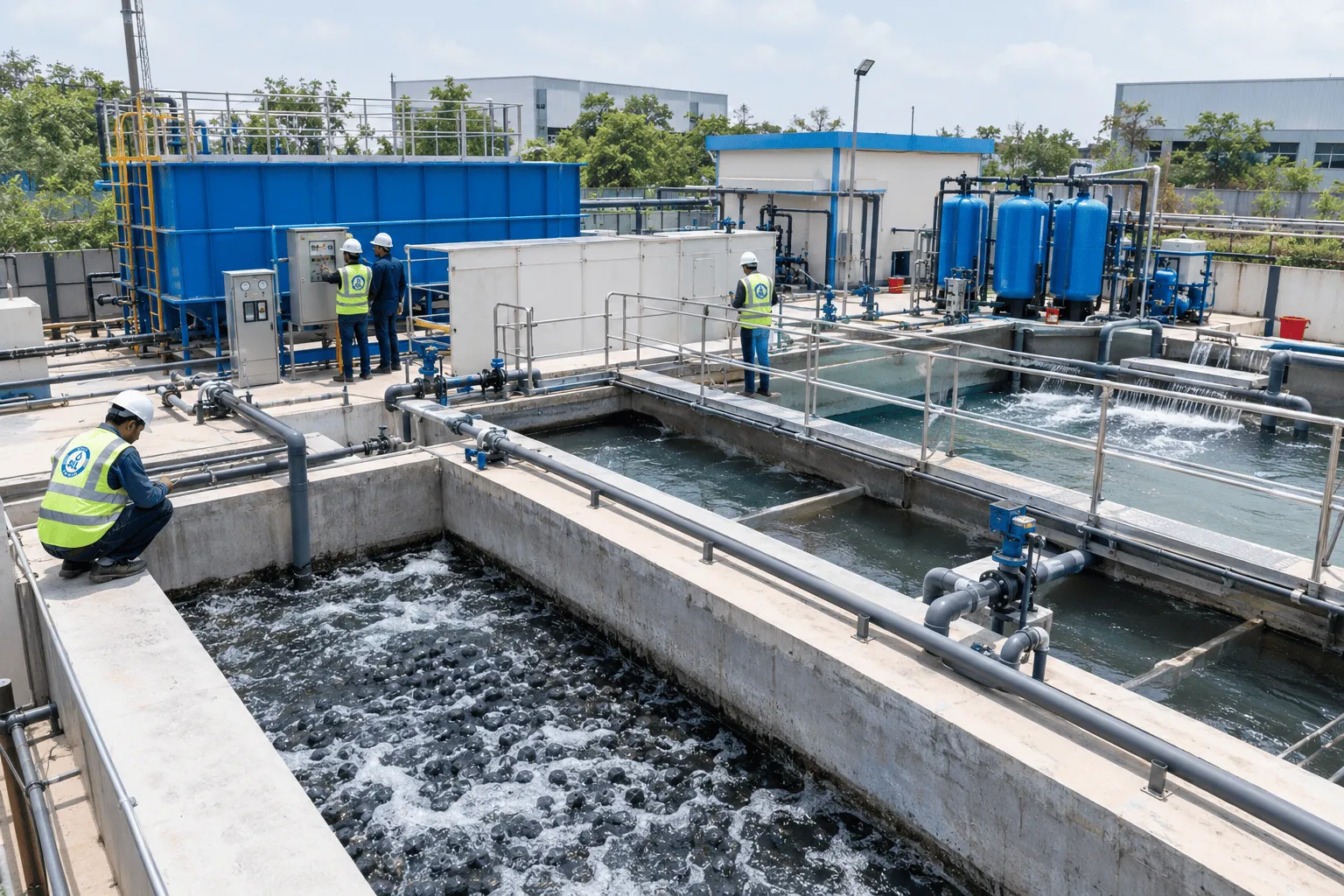
A Sewage Treatment Plant (STP) works through a systematic sequence of treatment stages. Each
stage is designed to remove a specific type of contaminant and prepare the wastewater for
the next treatment step. The overall working process can be explained as follows:
1. Sewage Collection and Inlet: Wastewater generated from toilets,
bathrooms, kitchens, commercial areas, and other sources is collected through a
sewer network and directed to the STP inlet. The incoming sewage is first inspected
for flow and basic characteristics before entering the treatment process.
2. Screening: The wastewater passes through coarse and fine screens
that remove larger materials such as plastics, cloth, paper, sanitary waste, and
other floating debris. This protects pumps, pipelines, blowers, and downstream
treatment equipment from blockage or mechanical damage.
3. Grit and Solid Removal: After screening, heavier inorganic
particles such as sand, grit, gravel, and small stones are separated. Removing these
materials prevents abrasion and accumulation inside tanks and mechanical equipment.
4. Equalization and Flow Balancing: An equalization tank may be
provided to balance variations in wastewater flow and pollutant concentration. It
helps maintain a more consistent flow to the biological treatment section,
particularly where sewage generation varies significantly throughout the day.
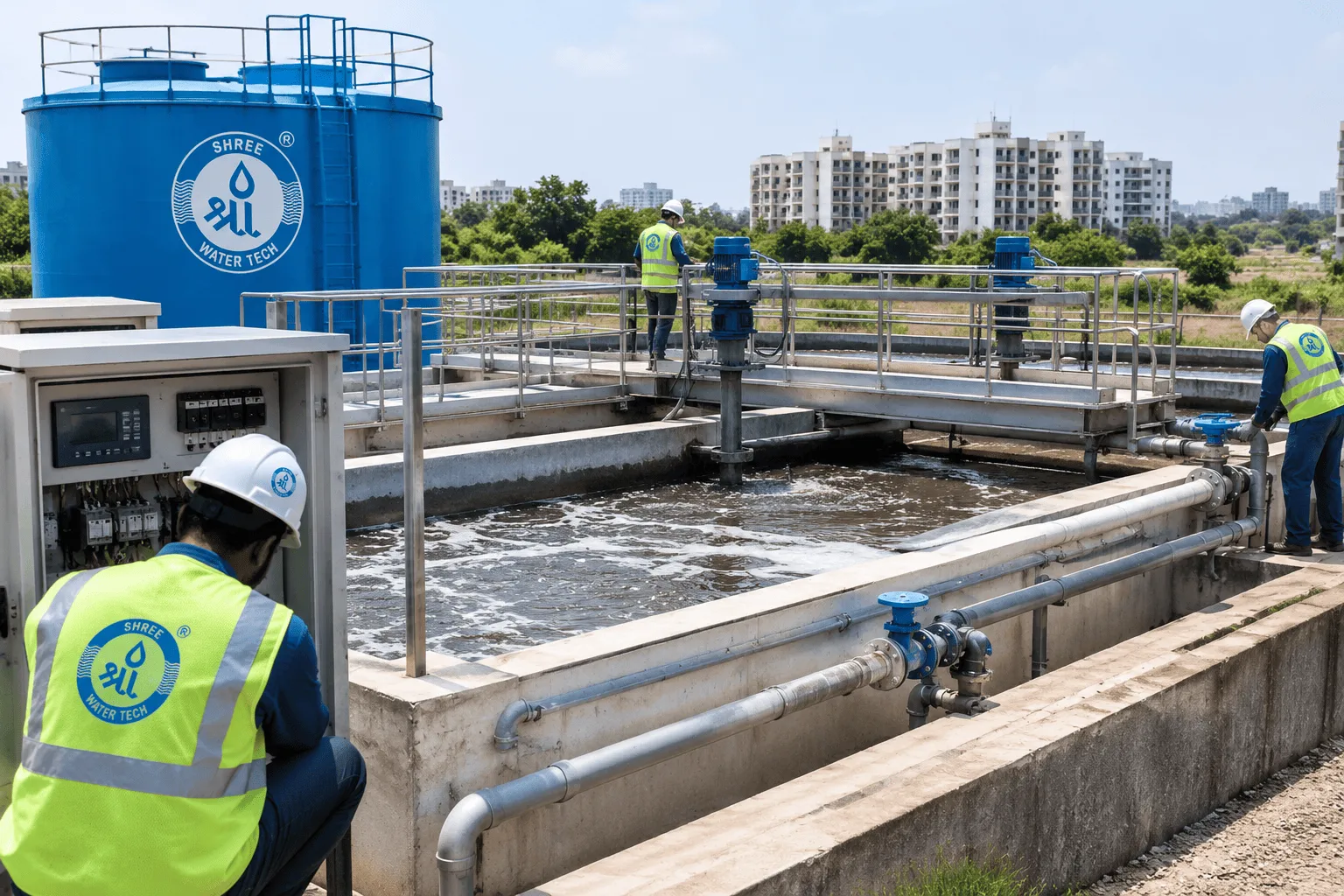
5. Biological Treatment: Depending on the selected STP technology,
biological treatment may use MBBR, SBR, MBR, or Activated Sludge Process (ASP).
Aeration equipment supplies oxygen when required to support aerobic microorganisms.
6. Solid-Liquid Separation: Following biological treatment,
microorganisms and suspended solids must be separated from the treated water.
Conventional systems generally use a clarifier for settling, while membrane-based
systems use filtration membranes.
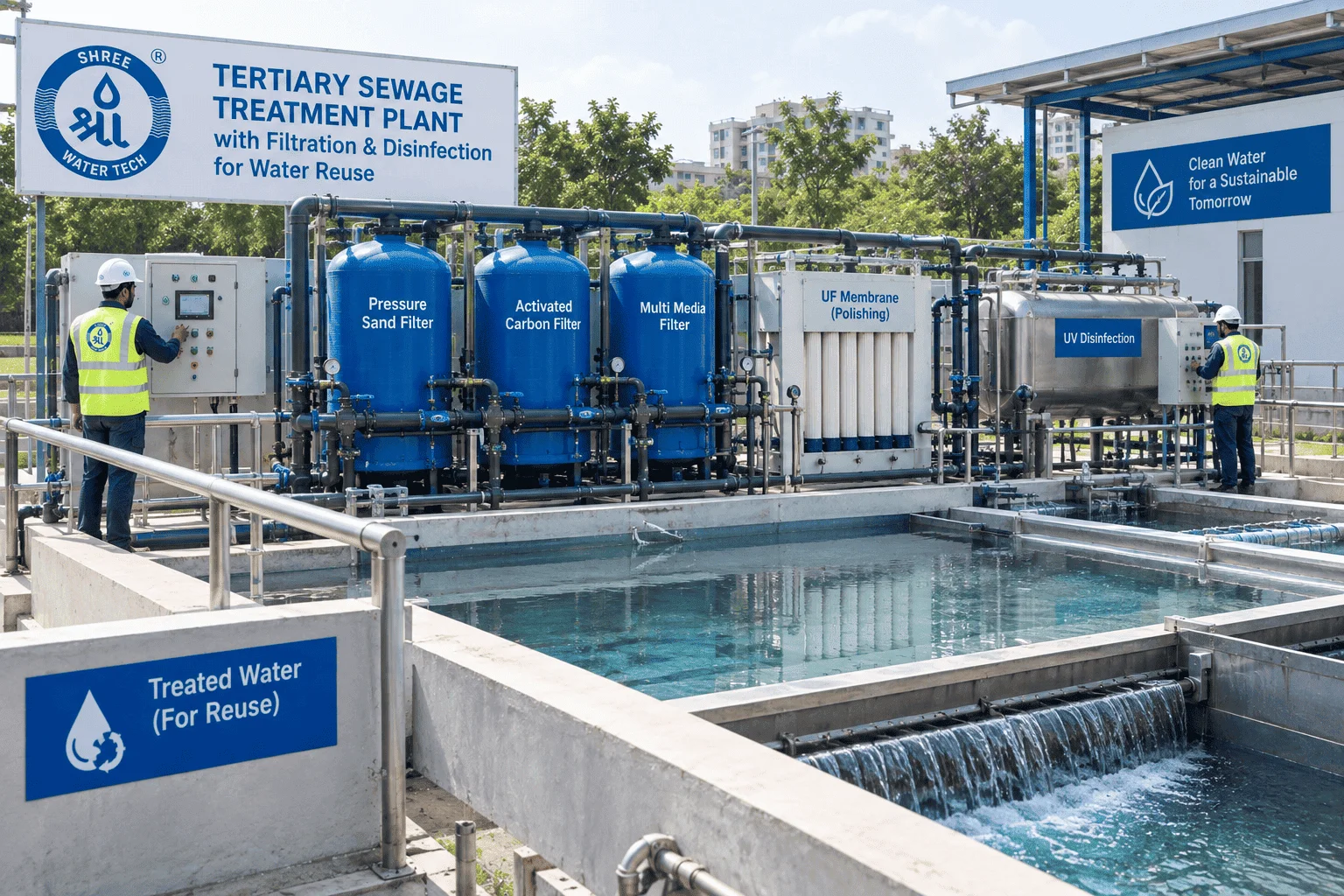
7. Tertiary Treatment: Additional treatment is provided when the
required treated-water quality is higher than that achieved through secondary
treatment alone. Depending on the application, this stage may include pressure sand
filtration, activated carbon filtration, ultrafiltration, membrane treatment, or
nutrient removal.
8. Disinfection: The filtered water undergoes disinfection to
reduce microorganisms. Ultraviolet (UV) treatment or chlorination may be used
depending on the plant design and intended reuse or discharge requirements.
9. Treated Water Collection and Reuse: After completing the
required treatment stages, the treated water is collected in a treated-water tank.
Subject to applicable quality requirements, it may be used for non-potable purposes
such as toilet flushing, gardening, landscaping, or other approved applications, or
discharged through the designated outlet.
10. Sludge Handling: Solids separated during the treatment process
are collected for sludge management. Depending on the plant configuration, sludge
may undergo thickening, stabilization, drying, or mechanical dewatering before
appropriate disposal or further processing.
Types of Sewage Treatment Plants
Sewage Treatment Plants (STPs) are designed in different configurations according to sewage
characteristics, treatment capacity, available space, treated-water quality requirements,
installation conditions, and the intended reuse of treated water. Different biological and
physical treatment technologies are selected depending on factors such as BOD, COD, TSS,
nitrogen, phosphorus, hydraulic loading, peak flow, and discharge or reuse standards. The
major types of sewage treatment plants include MBBR, SBR, MBR, ASP, extended aeration, FAB,
packaged, prefab, modular, containerized, decentralized, and tertiary treatment systems.
1. MBBR Sewage Treatment Plant
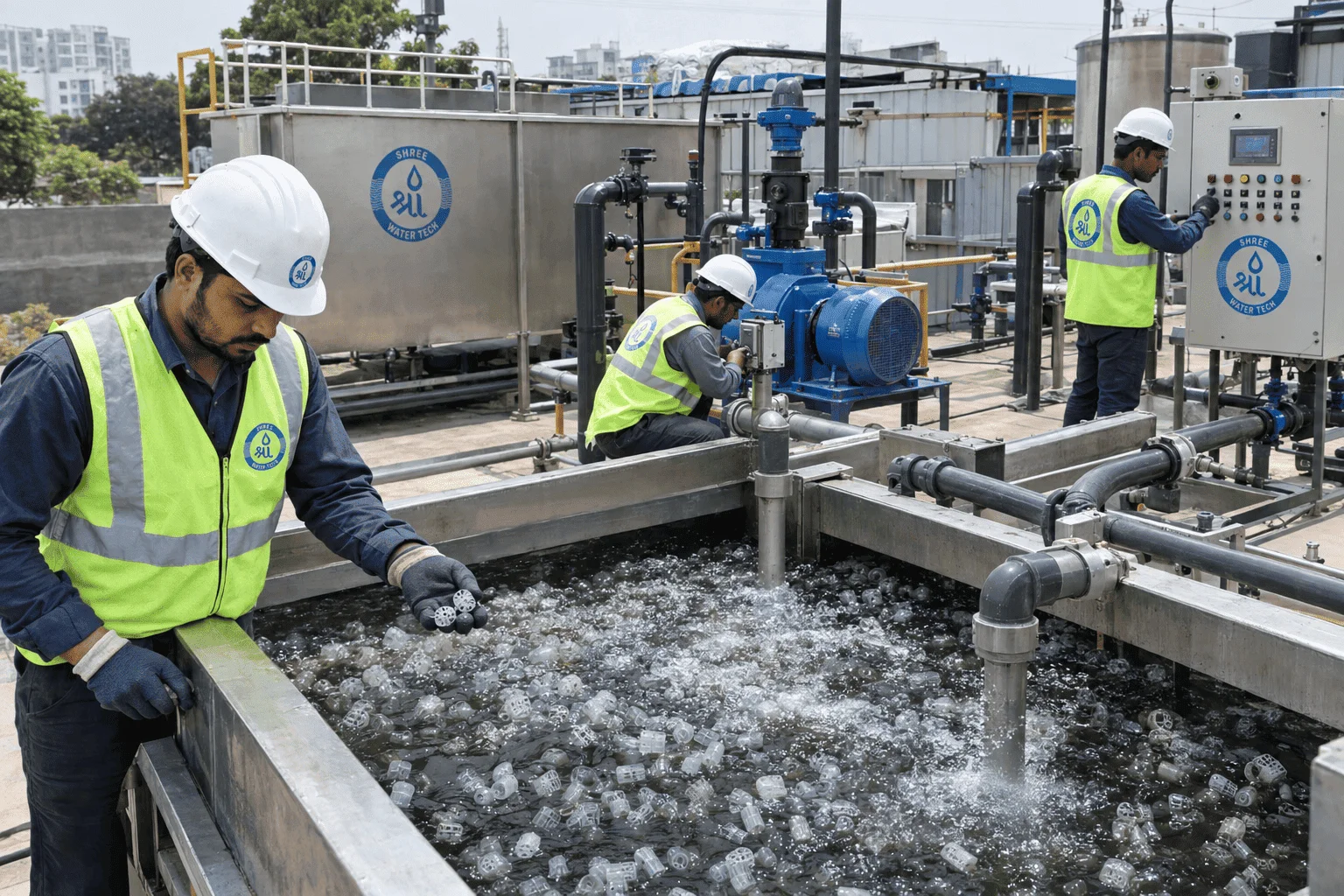
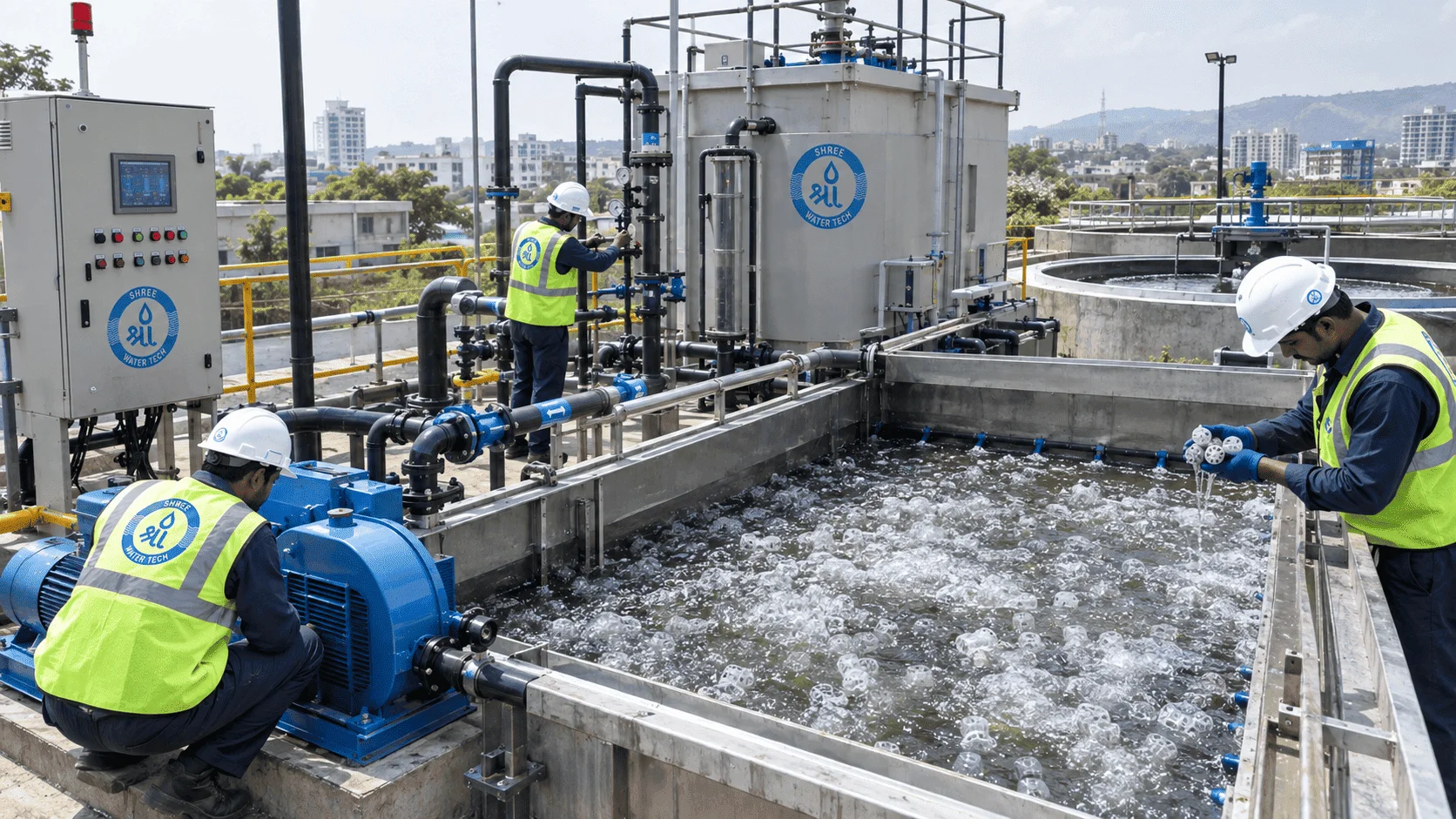
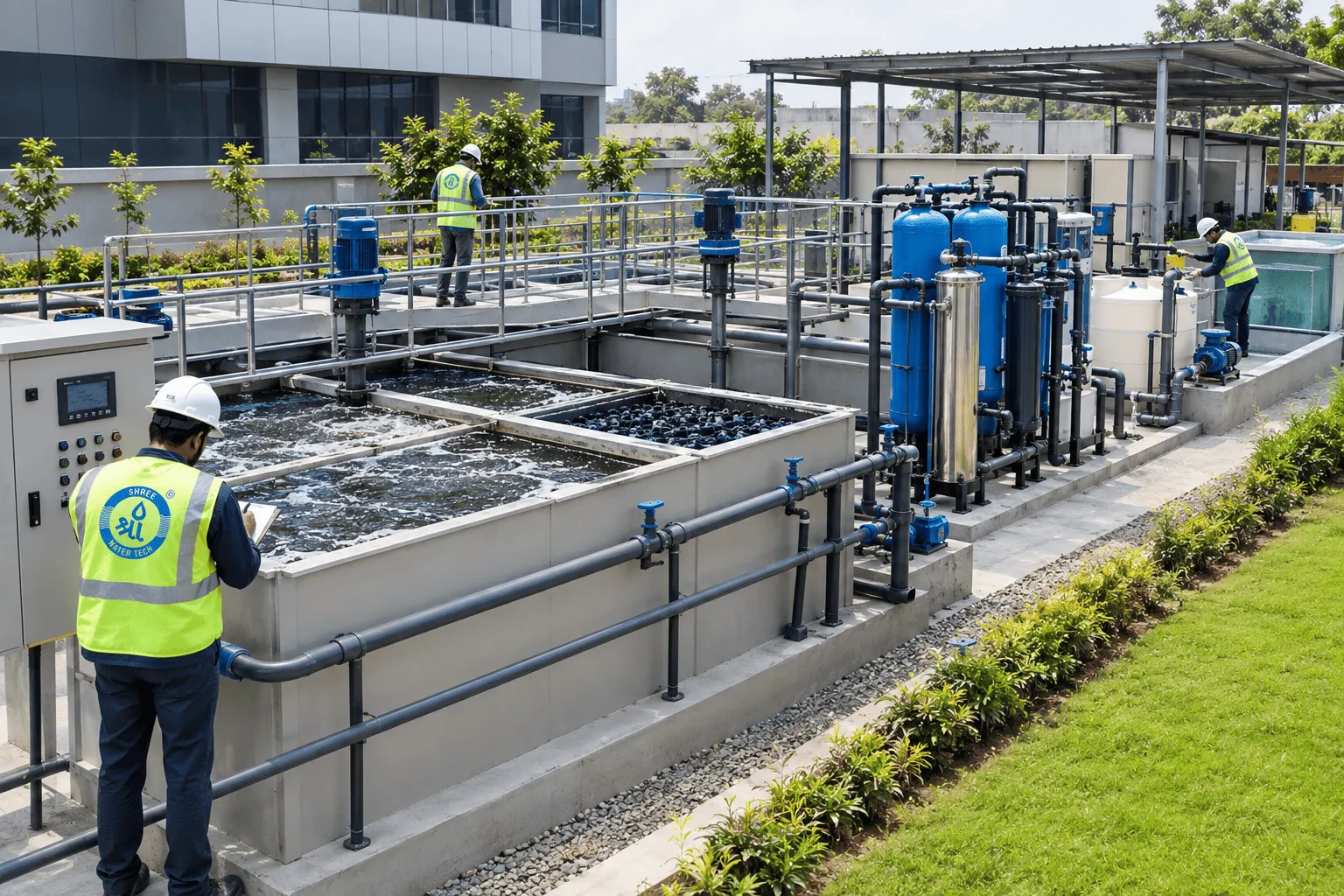
A Moving Bed Biofilm Reactor (MBBR) Sewage Treatment Plant
uses specially designed plastic biofilm carriers inside an aeration tank to
provide a large protected surface area for microorganisms. The
microorganisms grow as a biofilm on the carriers and biologically degrade
organic pollutants present in sewage. Continuous aeration keeps the carriers
moving and maintains contact between sewage, microorganisms, and oxygen.
MBBR STPs are commonly used for residential complexes, commercial buildings,
hotels, hospitals, institutions, and industrial facilities where reliable
biological treatment and compact plant construction are required. They are
particularly suitable when the plant needs higher treatment efficiency
without substantially increasing the tank volume. Compared with conventional
activated sludge systems, MBBR can provide greater biomass retention and is
relatively flexible under variations in organic loading.
Technical considerations: Reactor sizing
depends on organic loading, carrier filling ratio, required oxygen transfer,
hydraulic retention time, influent BOD/COD, and required treated-water
quality. Typical systems incorporate screening, equalization, primary
treatment, MBBR aeration, secondary clarification, sludge handling, and
optional tertiary treatment.
A Sequencing Batch Reactor (SBR) Sewage Treatment Plant
performs biological treatment in a controlled sequence within the same
reactor. Typical operating cycles include fill, react, settle,
decant, and idle stages. Aeration and mixing are controlled
according to the treatment cycle, allowing biological oxidation and solids
separation to take place in a batch-based process.
SBR systems are used where consistent treatment performance, automation, and
efficient use of plant area are important. They are particularly suitable
for residential developments, institutions, hotels, commercial complexes,
and projects where the sewage flow varies throughout the day. Unlike
continuous-flow MBBR systems, SBR uses timed treatment cycles and does not
necessarily require a separate secondary clarifier.
Technical considerations: Cycle duration,
reactor volume, aeration time, settling period, decant volume, sludge
wasting rate, dissolved oxygen, and influent loading must be carefully
controlled. PLC-based automation is commonly used for blower operation,
mixers, decanters, valves, and treatment-cycle sequencing.
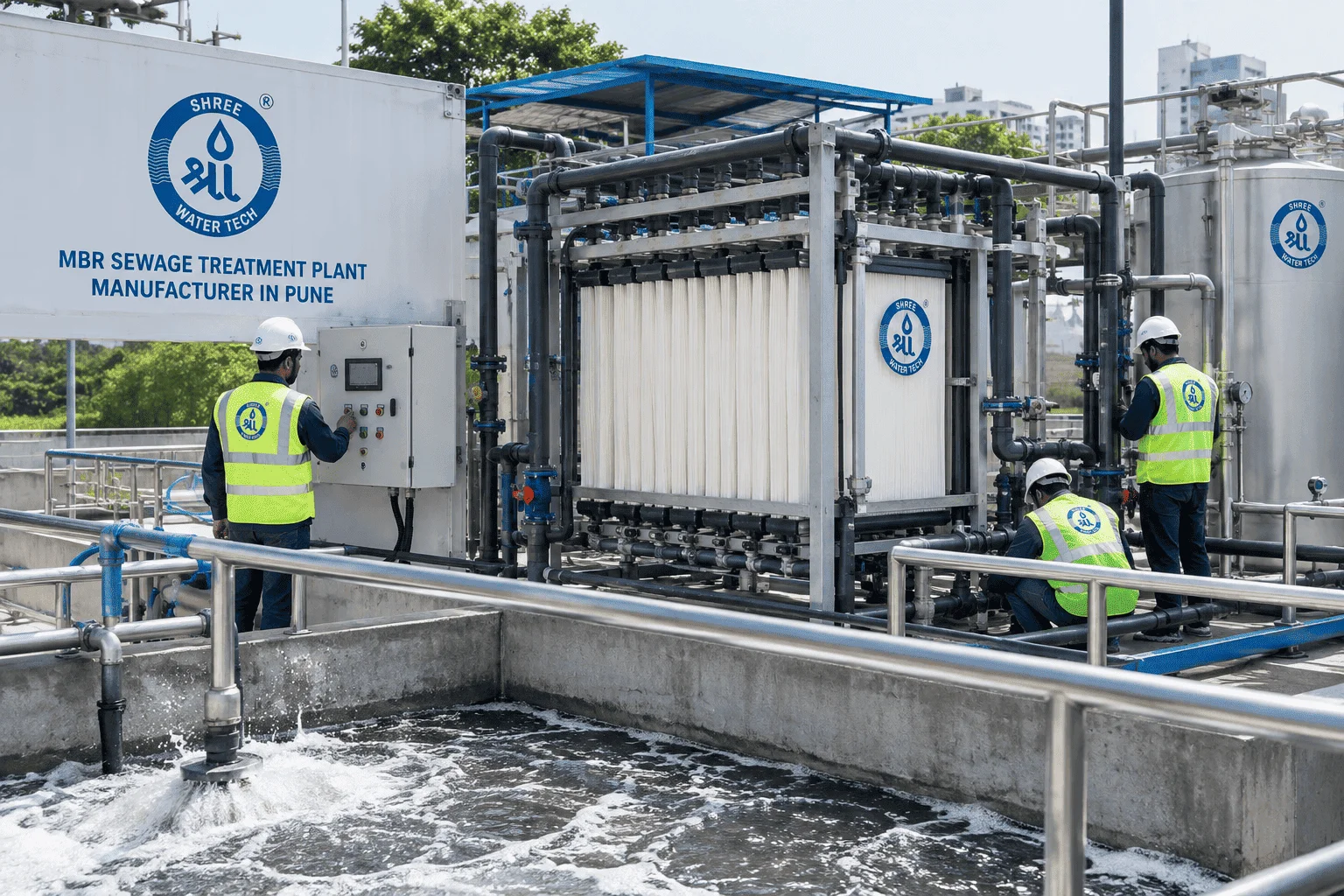
A Membrane Bioreactor (MBR) Sewage Treatment Plant combines
biological treatment with membrane filtration. Microorganisms degrade
organic matter in the bioreactor, while membranes provide fine solid-liquid
separation. Depending on the system configuration, submerged or external
membrane modules can be used to produce highly clarified treated water with
very low suspended solids.
MBR technology is selected when high-quality treated water is required,
particularly for applications involving water reuse, toilet flushing,
landscaping, cooling, process applications, or other non-potable purposes.
It can achieve a smaller footprint than conventional biological treatment
followed by separate clarification and advanced filtration because membrane
separation replaces conventional secondary settling.
Technical considerations: Membrane flux,
transmembrane pressure, mixed liquor suspended solids, membrane fouling, air
scouring, sludge retention time, cleaning frequency, and membrane
replacement requirements are important design parameters. MBR systems
generally require closer operational control than simpler biological STPs.
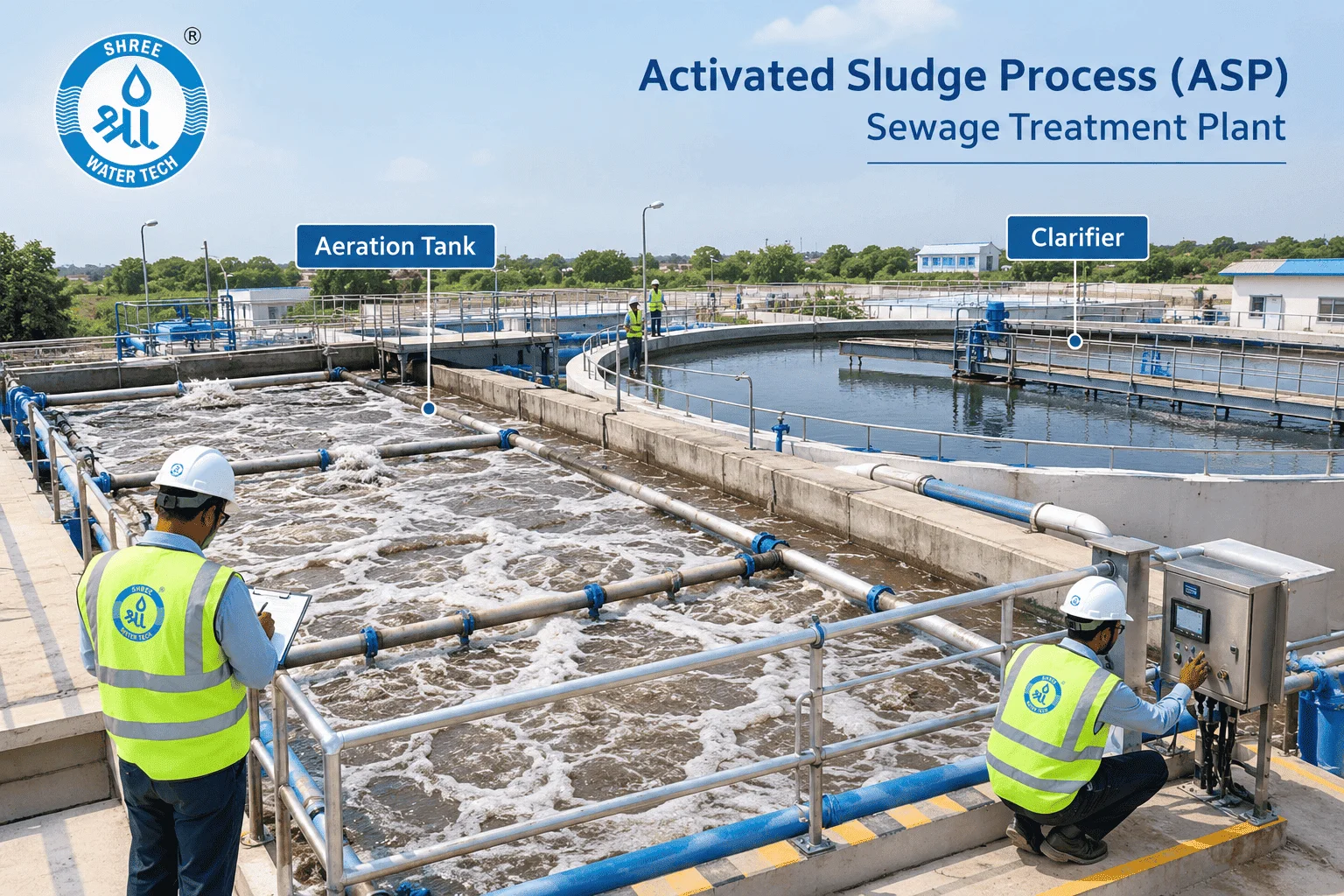
4. Activated Sludge Process (ASP) Sewage Treatment Plant
An Activated Sludge Process (ASP) Sewage Treatment Plant
uses suspended microorganisms in an aeration tank to biologically oxidize
organic pollutants. Air or oxygen is supplied to maintain the microorganisms
under aerobic conditions, after which the mixed liquor flows to a secondary
clarifier where biological solids settle. A portion of the settled sludge is
returned to the aeration tank as return activated sludge (RAS), while excess
sludge is removed for further handling.
ASP is used for municipal, residential, institutional, and commercial sewage
treatment where a conventional continuous-flow biological treatment process
is appropriate. It is a well-established technology and can be adapted to
different treatment capacities and effluent requirements.
Technical considerations: Important
parameters include mixed liquor suspended solids (MLSS), dissolved oxygen,
sludge retention time (SRT), food-to-microorganism ratio (F/M), return
sludge rate, hydraulic retention time, sludge volume index (SVI), and
secondary clarifier loading. Compared with attached-growth systems such as
MBBR, ASP depends more heavily on maintaining the required suspended biomass
concentration and sludge settling characteristics.
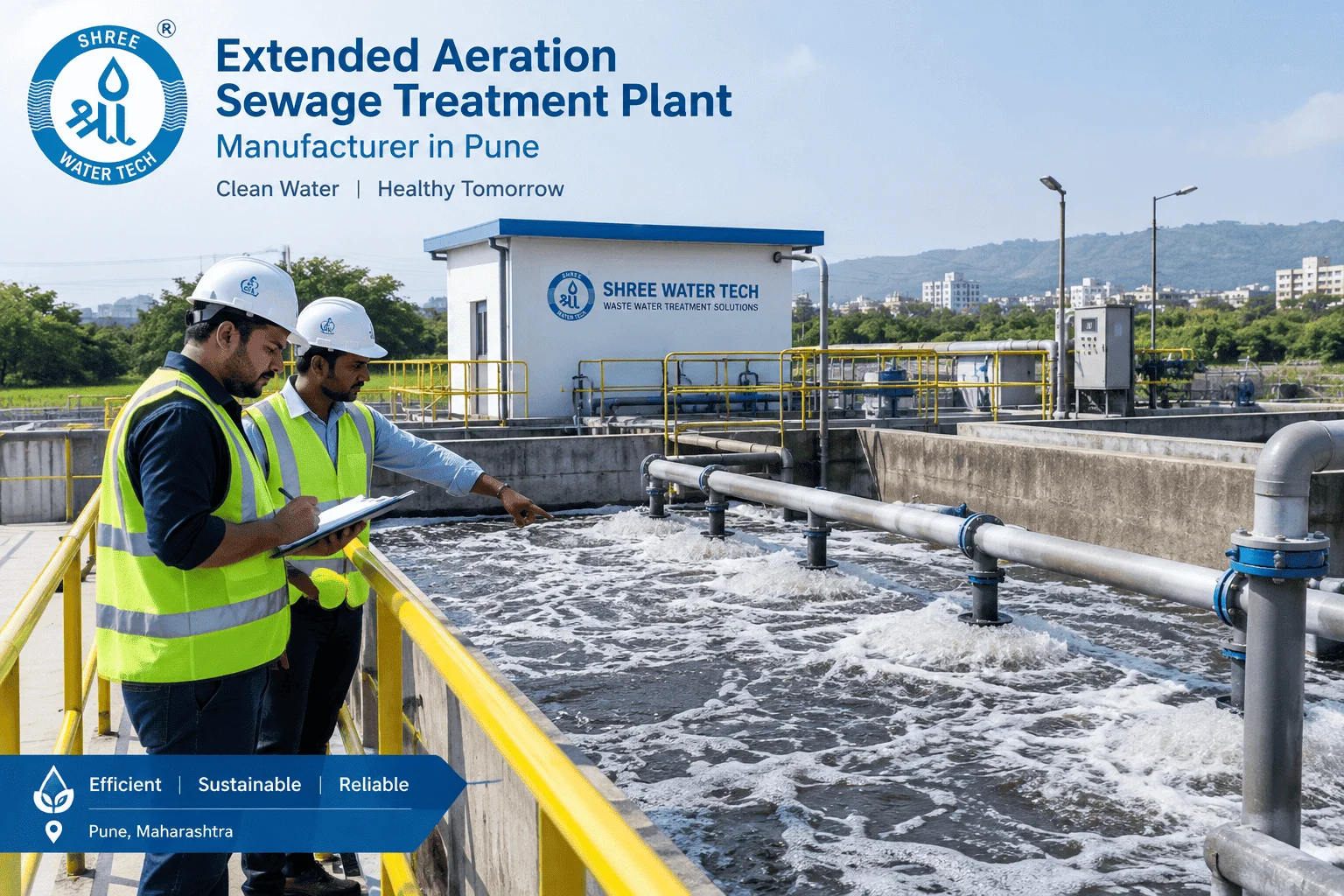
An Extended Aeration Sewage Treatment Plant is a modified
activated sludge process operated with a relatively long aeration period and
a low food-to-microorganism ratio. The longer biological retention allows
microorganisms to stabilize more organic matter and promotes endogenous
respiration, resulting in comparatively lower excess sludge production than
conventional high-rate activated sludge systems.
Extended aeration is commonly selected for residential societies, schools,
hospitals, hotels, institutions, and other facilities where sewage flow is
relatively predictable and simple biological operation is preferred. It is
useful where sludge handling requirements need to be minimized and
sufficient space is available for longer biological retention.
Technical considerations: Aeration tank
volume, oxygen demand, MLSS, SRT, F/M ratio, dissolved oxygen, settling
characteristics, and sludge wasting are important design factors. The longer
aeration requirement can increase blower energy consumption compared with
some compact treatment configurations.
A Fluidized Aerobic Bed (FAB) Sewage Treatment Plant uses
small media particles or carriers on which microorganisms grow as biofilm.
Aeration keeps the media in suspension and provides oxygen for biological
treatment. The attached biomass increases the effective biological surface
area within the reactor and supports the degradation of organic pollutants.
FAB systems are used where compact biological treatment and relatively high
biomass concentration are required. They can be considered for residential,
commercial, institutional, and industrial sewage applications where
available installation space is limited.
Technical considerations: Media
characteristics, media loading, aeration rate, oxygen transfer, hydraulic
retention time, organic loading, and solids separation are important design
parameters. The media and reactor configuration differentiate FAB systems
from conventional suspended-growth activated sludge plants.
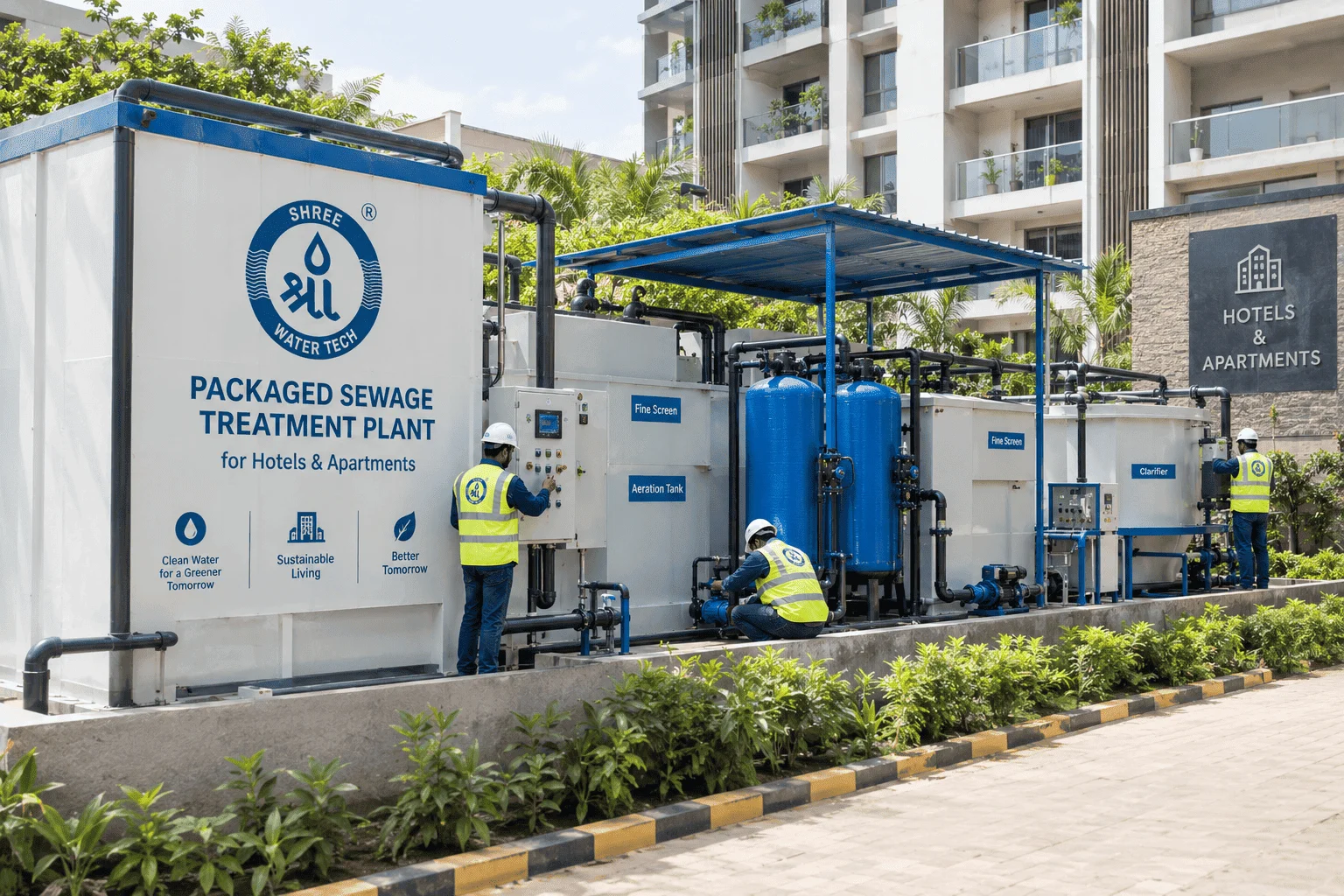
A Packaged Sewage Treatment Plant is a factory-assembled or
factory-fabricated treatment system supplied as a compact package with major
treatment components integrated into a defined plant configuration.
Depending on the application, packaged systems may use MBBR, SBR, FAB,
extended aeration, or other biological processes.
Packaged STPs are commonly used for apartments, hotels, resorts, schools,
hospitals, offices, commercial buildings, and smaller industrial facilities
where rapid installation and a compact footprint are required. They are
useful when the project requires a standardized treatment package rather
than extensive civil construction at the site.
Technical considerations: Selection depends
on sewage flow, peak hydraulic loading, BOD/COD concentration, TSS,
treatment objectives, available installation area, tank material, automation
requirements, and treated-water reuse. The term packaged describes the
supply format and compact integration; it does not itself define a
particular biological treatment process.
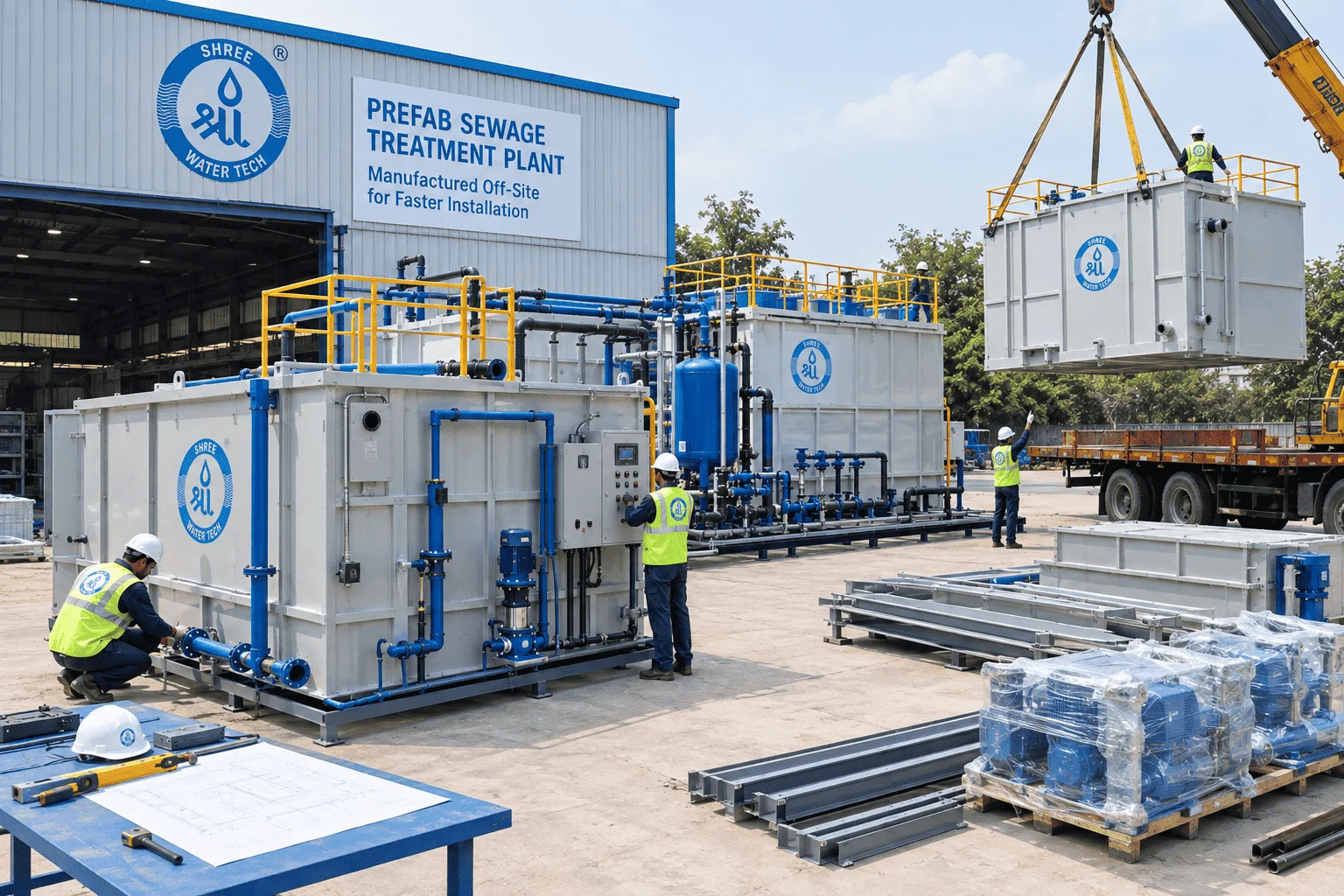
A Prefab Sewage Treatment
Plant is manufactured or fabricated off-site in sections, tanks,
modules, or assemblies and then transported to the project location for
installation and commissioning. Prefabrication allows a substantial portion
of fabrication and quality control to be completed in a controlled
manufacturing environment before the equipment reaches the site.
Prefab STPs are used when faster site installation, reduced civil
construction, controlled fabrication, or limited construction space is
important. They are suitable for residential, commercial, institutional,
hospitality, and industrial projects where the treatment system needs to be
installed with comparatively less site fabrication.
Technical considerations: Structural
design, tank material, module dimensions, transportation limitations,
lifting requirements, interconnection piping, equipment accessibility,
corrosion protection, and site foundation requirements must be considered.
Prefabrication is primarily an installation and construction approach, so
the underlying treatment process may be MBBR, SBR, FAB, or another suitable
technology.
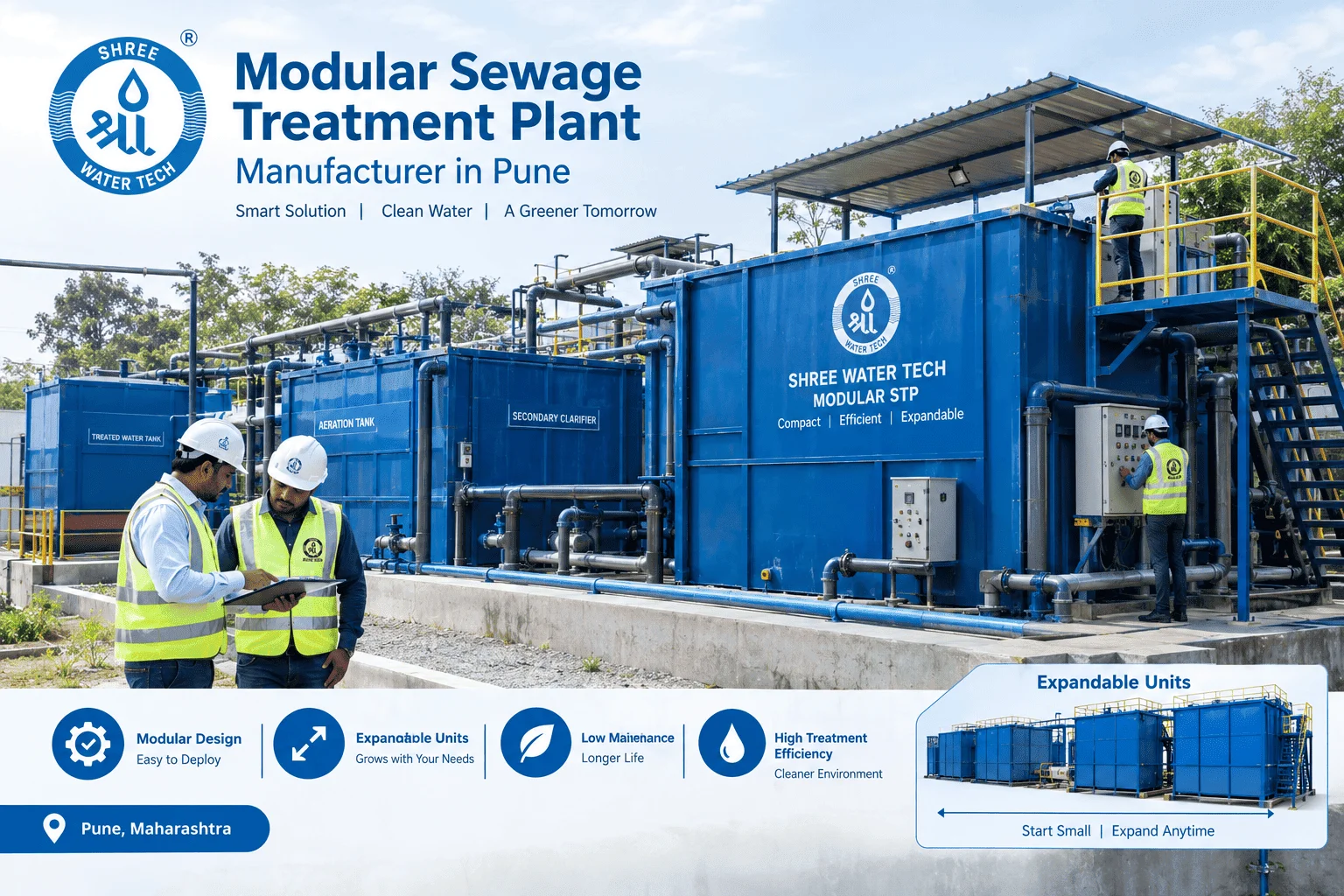
A Modular Sewage Treatment Plant consists of treatment units
designed as separate modules that can be assembled into a complete system.
Modules may include screening, equalization, biological treatment,
clarification, filtration, disinfection, sludge handling, and tertiary
treatment stages.
Modular STPs are useful for projects where treatment capacity may need to
increase over time or where the plant must adapt to changing site
requirements. They can be suitable for campuses, residential developments,
commercial facilities, industrial sites, and infrastructure projects with
phased expansion.
Technical considerations: Hydraulic flow
distribution, module capacity, interconnecting pipework, pumping
requirements, control logic, available space, future expansion provisions,
and equalization capacity should be considered during design. Additional
modules can be incorporated when the overall hydraulic and organic loading
requirements increase, subject to the original plant design.
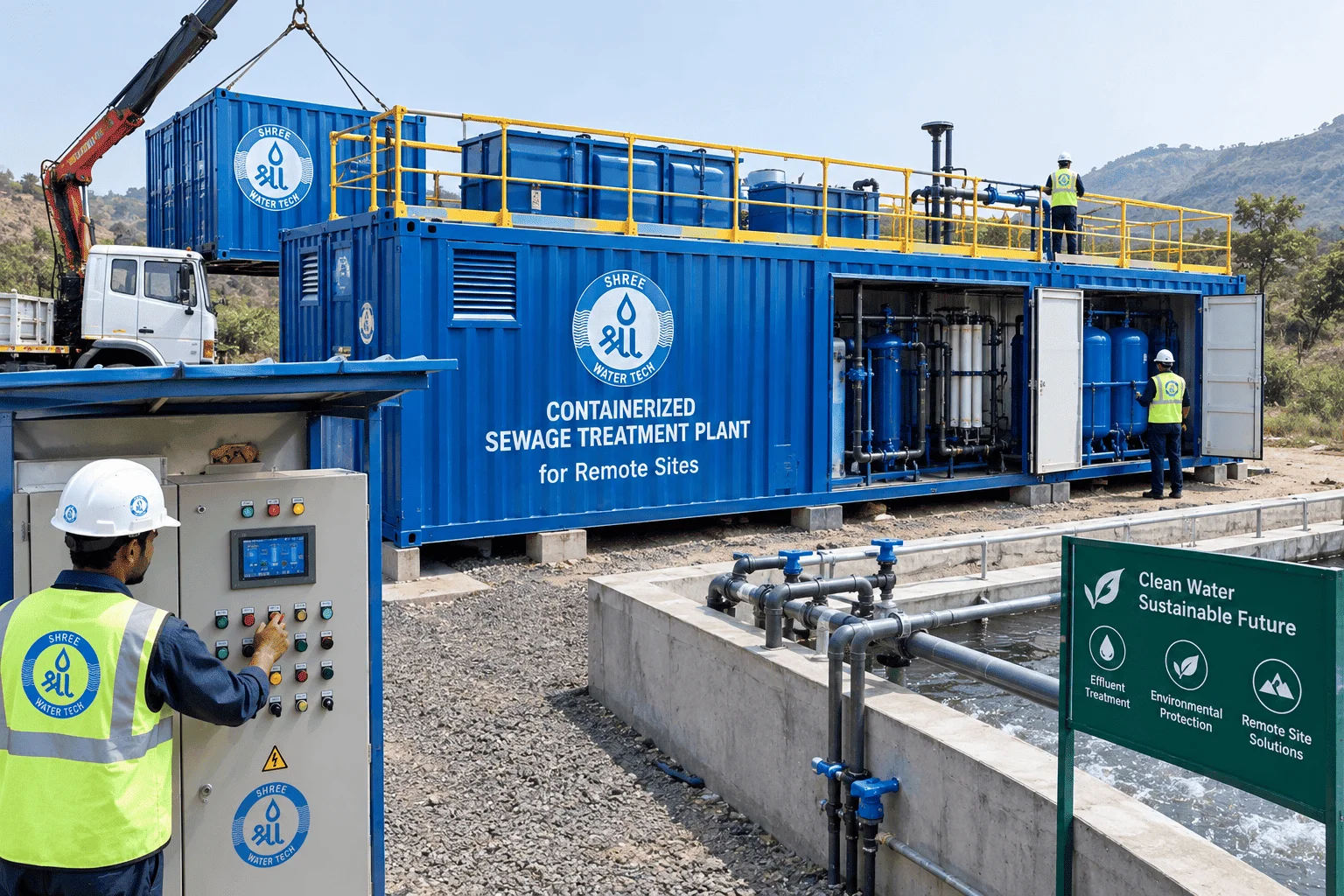
A Containerized Sewage
Treatment Plant integrates treatment equipment into a transportable
container or container-like enclosure. The system can be supplied with major
treatment equipment, electrical panels, piping, pumps, blowers, and control
systems pre-installed or assembled to reduce site installation work.
Containerized STPs are used for temporary facilities, remote locations,
construction camps, infrastructure projects, industrial sites, emergency
installations, and locations where conventional permanent construction is
difficult. Their transportability makes them useful when the treatment
system may need to be relocated or installed with limited site
infrastructure.
Technical considerations: Container
dimensions, equipment layout, ventilation, heat management, corrosion
protection, electrical requirements, access for maintenance, lifting and
transportation arrangements, and climatic conditions must be evaluated. The
containerized format can accommodate different treatment processes depending
on the required capacity and effluent quality.
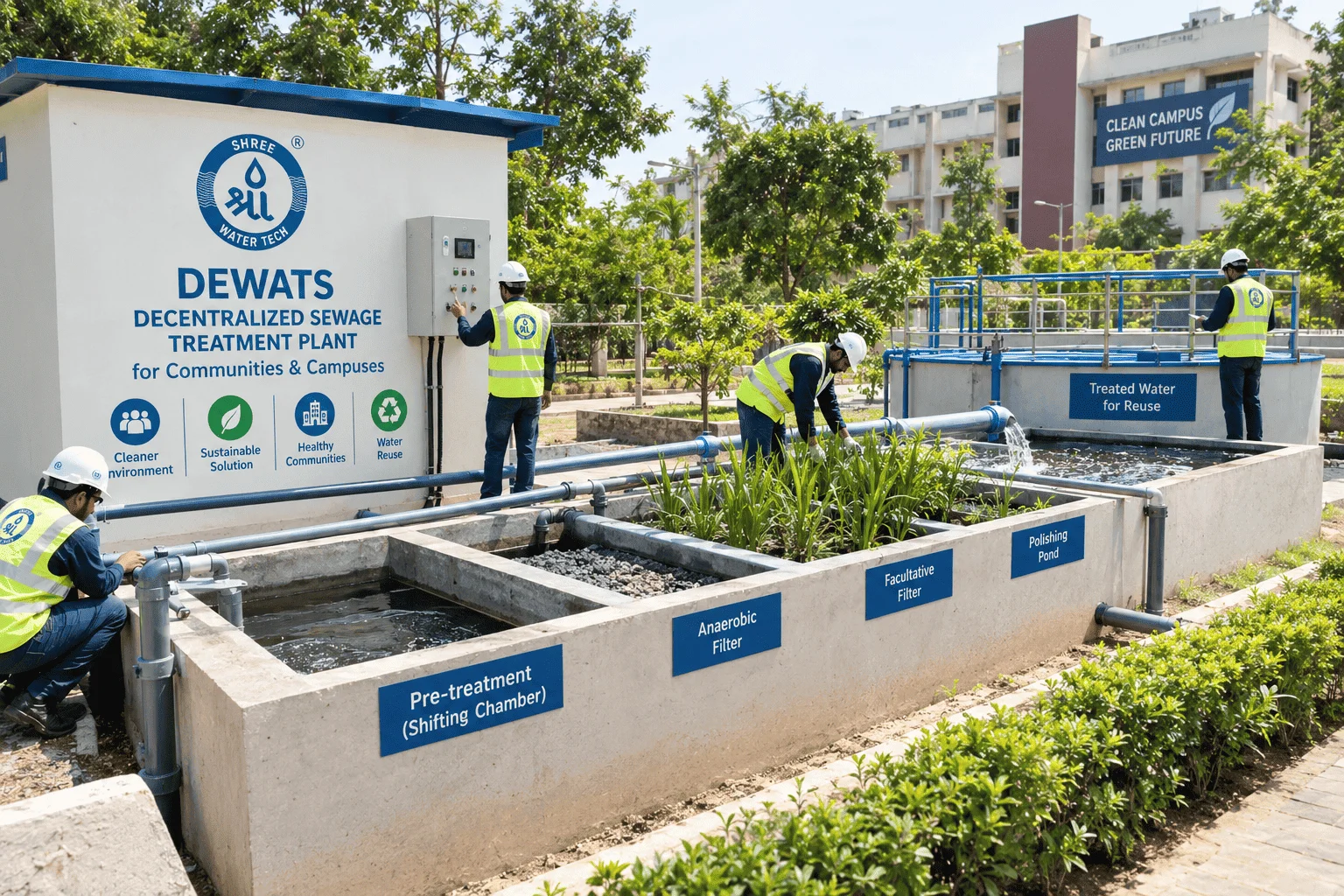
A Decentralized Wastewater Treatment System (DEWATS) treats
sewage close to the point where it is generated rather than transferring all
wastewater to a large centralized treatment facility. Depending on the
project, decentralized systems can combine processes such as settling,
anaerobic treatment, aerobic biological treatment, filtration, constructed
wetlands, and disinfection.
DEWATS is used for remote communities, institutions, residential clusters,
rural developments, campuses, resorts, and other locations where centralized
sewer infrastructure is unavailable or impractical. It reduces the need for
long-distance sewage conveyance and can be designed according to the
wastewater generation pattern of a specific local area.
Technical considerations: Local sewage
flow, influent characteristics, hydraulic retention time, anaerobic and
aerobic treatment stages, land availability, sludge management, odor
control, groundwater protection, and treated-water disposal or reuse must be
considered. The treatment configuration can vary significantly according to
local site conditions and project requirements.
A Tertiary Sewage Treatment Plant provides advanced
treatment after primary and secondary biological treatment to further
improve treated-water quality. Depending on the reuse or discharge
requirement, tertiary treatment can include pressure sand filtration,
activated carbon filtration, ultrafiltration, membrane treatment, nutrient
removal, advanced oxidation, and disinfection using chlorine, UV, or ozone.
Tertiary treatment is used when the treated sewage needs to meet more
stringent quality requirements or when the water is intended for reuse.
Common reuse applications include landscaping, toilet flushing,
cooling-water makeup, gardening, and selected industrial processes, subject
to the required water-quality criteria.
Technical considerations: The selection of
tertiary treatment depends on residual TSS, turbidity, BOD, COD, nutrients,
microbial quality, dissolved solids, and the final reuse requirement. For
example, filtration and disinfection may be sufficient for some reuse
applications, while membrane-based treatment may be required where
substantially lower suspended solids or dissolved contaminant levels are
needed.
Technical Comparison of Sewage Treatment Plant Technologies
PARAMETER
MBBR
SBR
MBR
ASP
EXTENDED AERATION
FAB
PACKAGED STP
PREFAB STP
MODULAR STP
CONTAINERIZED STP
DEWATS
TERTIARY STP
Technology
Moving Bed Biofilm Reactor
Sequential Batch Reactor
Membrane Bioreactor
Activated Sludge Process
Extended Aeration Process
Fluidized Aerobic Bed
Integrated Packaged Treatment
Off-site Prefabricated Treatment
Modular Treatment System
Containerized Treatment System
Decentralized Wastewater Treatment
Advanced Tertiary Treatment
Typical Capacity
25–5,000+ KLD
50–10,000+ KLD
50–5,000+ KLD
100–50,000+ KLD
25–2,000+ KLD
25–2,000+ KLD
10–2,000+ KLD
10–5,000+ KLD
25–10,000+ KLD
10–1,000+ KLD
10–1,000+ KLD
25–5,000+ KLD
Primary Biological Process
Attached-growth biofilm
Suspended-growth batch process
Suspended growth + membrane separation
Suspended-growth activated sludge
Suspended-growth aerobic process
Fluidized biofilm process
Depends on selected technology
Depends on selected technology
Depends on selected technology
Depends on selected technology
Anaerobic and/or aerobic treatment
Physical, chemical and membrane polishing
Typical HRT
Several hours
Cycle-based operation
Several hours
Several hours
Longer aeration period
Several hours
Process dependent
Process dependent
Process dependent
Process dependent
Process dependent
Short contact / filtration stages
Biomass Type
Attached biofilm + suspended biomass
Suspended biomass
Suspended biomass
Suspended biomass
Suspended biomass
Attached biofilm
Technology dependent
Technology dependent
Technology dependent
Technology dependent
Anaerobic / aerobic biomass
Not primarily biological
Media / Membrane
Plastic biofilm carriers
Generally no media
MF / UF membrane modules
No carrier media
No carrier media
Fluidized media
As per selected process
As per selected process
As per selected process
As per selected process
Filters / biological media as required
PSF / ACF / UF / membrane
Clarification
Secondary clarifier generally required
Integrated settling cycle
Membrane separation
Secondary clarifier required
Secondary clarifier generally required
Clarifier generally required
Process dependent
Process dependent
Process dependent
Process dependent
Settling / filtration
Advanced filtration
Aeration
Continuous aeration
Controlled aeration cycles
Continuous aeration + membrane air scouring
Continuous aeration
Extended continuous aeration
Continuous aeration
Process dependent
Process dependent
Process dependent
Process dependent
Depends on aerobic stage
Depends on selected treatment
Automation
PLC / HMI optional
PLC-based cycle control
PLC / HMI / membrane monitoring
PLC / automatic controls
PLC / automatic controls
PLC / automatic controls
Manual / automatic options
PLC / HMI options
PLC / HMI / SCADA options
PLC / HMI / remote monitoring
Manual / automatic options
PLC / HMI / SCADA
Footprint
Compact
Compact
Very compact
Moderate to large
Moderate to large
Compact
Compact
Compact to moderate
Expandable
Compact and transportable
Site dependent
Additional treatment footprint
Sludge Generation
Moderate
Moderate
Low to moderate
Moderate to high
Relatively low
Moderate
Process dependent
Process dependent
Process dependent
Process dependent
Low to moderate
Backwash / process residuals
Filtration
Optional tertiary filtration
Optional tertiary filtration
Integrated membrane filtration
Optional tertiary filtration
Optional tertiary filtration
Optional tertiary filtration
As required
As required
As required
As required
Configuration dependent
PSF / ACF / UF / membrane
Disinfection
UV / Chlorination
UV / Chlorination
UV / Chlorination
UV / Chlorination
UV / Chlorination
UV / Chlorination
As required
As required
As required
As required
As required
UV / Chlorination / Ozone
Typical Applications
Apartments, hotels, hospitals
Apartments, hotels, institutions
Water reuse applications
Municipal and commercial sewage
Residential societies and institutions
Residential and commercial projects
Hotels, offices, apartments
Residential and industrial projects
Campuses and phased projects
Remote and temporary sites
Communities and remote locations
Water reuse and advanced treatment
MBBR vs SBR vs MBR: Which STP Is Right for Your Project in Pune?
Most STP enquiries in Pune come down to three technologies. MBBR is a continuous-flow, compact process that tolerates load variation and is popular for apartments and commercial buildings. SBR treats sewage in timed batch cycles with PLC control and suits projects where flow changes through the day. MBR adds membrane filtration for very high treated-water quality in the smallest footprint, which is useful for reuse-focused projects. Our engineers compare these options against your sewage load, available space and reuse target before recommending a design.
Features and Benefits of Sewage Treatment Plant
As Sewage Treatment Plant Exporters in Pune, our products provide
several Features and Benefits including consistent quality, smooth finish, and long service
life.
Category
Feature
Benefit
Treatment Efficiency
Multi-stage wastewater treatment
Provides effective removal of different contaminants
Technology
MBBR, SBR, MBR, and ASP options
Allows selection of suitable technology for specific requirements
Design
Compact and modular construction
Optimizes available installation space
Operation
Continuous or batch operation
Provides flexibility according to plant configuration
Automation
PLC-based automatic controls
Simplifies operation and process monitoring
Energy Management
Efficient pumps and aeration equipment
Helps control energy consumption
Water Reuse
Treated-water recovery system
Supports suitable non-potable water reuse
Filtration
PSF, ACF, UF, or membrane options
Improves treated-water quality
Disinfection
UV or chlorination system
Helps reduce microorganisms in treated water
Sludge Management
Sludge collection and dewatering
Enables controlled handling of treatment solids
Construction
MS, SS, FRP, or RCC options
Allows material selection according to site conditions
Maintenance
Accessible equipment and service points
Makes routine servicing easier
Monitoring
Flow, pH, DO, level, and other instrumentation
Supports process control and performance monitoring
How to Choose the Right STP Plant for Your Project?
Selecting the right Sewage Treatment Plant depends on the wastewater characteristics,
required treatment capacity, available space, treated-water quality, and operating
requirements of the project. Consider the following factors before finalizing an STP
technology:
Wastewater Flow and Capacity: Determine average and peak sewage
flow, occupancy, water consumption, and future expansion requirements to establish
the appropriate KLD capacity.
Wastewater Quality: Evaluate parameters such as BOD, COD, TSS, pH,
nitrogen, phosphorus, oil, and grease to select a suitable treatment process.
Available Space: Consider the footprint required for tanks,
equipment, piping, electrical panels, access, and maintenance areas. Compact options
such as MBBR, MBR, and packaged systems may suit space-constrained sites.
Treated-Water Requirement: Identify whether the treated water will
be discharged or reused for applications such as toilet flushing, gardening,
landscaping, or other approved non-potable purposes.
Automation and Operation: Consider PLC-based controls, sensors,
alarms, and monitoring requirements based on operator availability and project
needs.
Sludge and Maintenance: Evaluate sludge generation, dewatering,
disposal, equipment maintenance, energy consumption, and other long-term operating
requirements.
Lifecycle Cost: Compare the complete lifecycle requirements,
including installation, electricity, chemicals, consumables, maintenance, manpower,
and equipment replacement—not only the initial purchase price.
A proper STP selection should therefore be based on the project's actual wastewater
characteristics and treatment objectives rather than selecting a technology based only on
capacity or price.
Applications of Sewage Treatment Plant
As Sewage Treatment Plant Manufacturers in Pune, our all types are used in various types of
industrial sectors such as:
Residential Communities: Apartment complexes, housing societies,
townships, and residential developments generate wastewater from bathrooms,
kitchens, laundry, and other domestic activities.
Hotels and Resorts: Guest rooms, restaurants, kitchens, laundry
facilities, and recreational areas can generate significant wastewater requiring
centralized treatment.
Hospitals: Healthcare facilities require carefully planned
wastewater treatment systems based on their wastewater sources and applicable
requirements.
Educational Institutions: Schools, colleges, universities, hostels,
and campuses can use decentralized or centralized treatment facilities.
Municipalities: Municipal wastewater projects can use large-scale
treatment infrastructure to serve communities and urban areas.
Industrial Facilities: Industrial premises may require an STP for
domestic sewage generated by employees and supporting facilities. Industrial process
wastewater may require a separate Effluent
Treatment Plant (ETP) or another specialized treatment system.
Indian Railways: Railway stations, residential colonies, workshops,
and associated facilities can use specialized wastewater treatment solutions
according to site requirements.
Sugar Industry: Sugar manufacturing facilities may require sewage
treatment for domestic wastewater generated within their premises, while process
effluent generally requires separate evaluation.
Ships and Off-Grid Locations: Marine facilities and remote
locations may require compact systems where connection to centralized sewer
infrastructure is not practical.
STP Installation Areas We Serve in Pune
Shree Water Tech supplies and installs sewage treatment plants across Pune city and the surrounding industrial and residential belts. Our team regularly supports projects in:
Pimpri-Chinchwad, Wakad, Pimple Saudagar and Ravet: STP for housing societies, offices and hospitals.
Hinjewadi, Baner, Balewadi and Aundh: STP for IT parks, apartment complexes and commercial buildings.
Kharadi, Viman Nagar, Hadapsar and Magarpatta: STP for residential towers, hotels and business parks.
Chakan, Talegaon, Ranjangaon and Bhosari MIDC: STP for industrial campuses, with ETP support for process effluent.
Kothrud, Warje, Katraj and Pune Camp: compact packaged and prefab STP for space-constrained sites.
STP capacity is normally expressed in KLD (Kilolitres per Day). 1 KLD = 1,000 litres/day =
1 cubic metre/day
The required capacity should be calculated from actual sewage generation rather than selected
solely on the basis of building size or available space.
Common Capacity Examples
Capacity
Daily Volume
Approximate Hourly Average
25 KLD
25,000 L/day
1,042 L/hour
50 KLD
50,000 L/day
2,083 L/hour
100 KLD
100,000 L/day
4,167 L/hour
250 KLD
250,000 L/day
10,417 L/hour
500 KLD
500,000 L/day
20,833 L/hour
700 KLD
700,000 L/day
29,167 L/hour
1,000 KLD
1,000,000 L/day
41,667 L/hour
For example, a 100 KLD system represents a nominal daily treatment volume of 100,000 litres
under its design conditions.
Capacity calculation should consider average flow, peak flow, occupancy, water consumption,
sewage-generation rate, seasonal variations, and possible future expansion.
STP Plant Cost in Pune: What Affects the Price?
Customers often ask for the cost of a sewage treatment plant in Pune. Because every site is different, there is no single price per KLD that applies to all projects. The main cost drivers are:
Capacity (KLD): Larger plants cost more overall, but the cost per KLD usually falls as capacity increases.
Technology: MBBR, SBR, MBR, ASP and FAB differ in equipment, automation and membrane or media requirements.
Construction material: MS, SS, FRP or RCC tanks, and whether the plant is packaged, prefab, modular or built on site.
Treated-water quality: Tertiary treatment such as PSF, ACF, UF and UV adds cost but supports higher reuse.
Automation level: Manual, semi-automatic or PLC/SCADA-based controls.
Site conditions: Civil work, space limits, power availability and transport.
Operating cost: Electricity, chemicals, manpower, sludge disposal and AMC over the plant's life.
To get an accurate quotation for a 50 KLD, 100 KLD, 250 KLD, 500 KLD or 700 KLD STP, send us your requirement with the building type, number of occupants and treated-water use.
Sewage Treatment Plant Installation & Maintenance
Installation begins with site assessment and preparation. Equipment is then positioned and
interconnected through process piping, electrical connections, control systems, and
supporting infrastructure.
The commissioning stage includes equipment
testing, trial operation, process adjustment, and operator training.
Regular maintenance is necessary to maintain stable performance. Typical activities include:
Checking pumps and blowers
Cleaning screens
Inspecting diffusers
Monitoring aeration
Backwashing filters
Checking membrane performance, where applicable
Removing accumulated sludge
Inspecting electrical panels
Monitoring treated-water quality
A preventive maintenance program (STP AMC) can reduce
unplanned downtime and help identify equipment problems before they affect the treatment
process.
Sewage Treatment Plant Case Studies
Shree Water Tech has applied different STP technologies across residential, commercial, industrial and hospitality projects. Design values and, where available, lab-measured results are shown separately for each project.
Case Study 1: 500 KLD SBR Sewage Treatment Plant in Wakad, Pune — Residential Township
Project Overview
Shree Water Tech designed, manufactured, installed and commissioned a 500 KLD Sequencing Batch Reactor (SBR) sewage treatment plant for a residential township. The plant treats domestic sewage for reuse in non-potable applications.
Project Snapshot
Parameter
Project Specification
Location
Wakad, Pune, Maharashtra
Executed By
Shree Water Tech – complete project handled by our team
The township's sewage generation varies with occupancy, and the client wanted to reuse as much treated water as possible instead of discharging it.
Shree Water Tech's Solution
An SBR configuration was selected because it carries out biological treatment and settling in controlled batch cycles within the same tank, which suits variable flow.
Calculated from the design figures above. These are design values, not measured results.
Project Outcome
The plant is designed to supply up to about 350 KLD of treated water for flushing, gardening & landscaping.
Case Study 2: 250 KLD MBBR Sewage Treatment Plant in Pune — Commercial Facility
Project Overview
Shree Water Tech designed, supplied, installed and commissioned a 250 KLD Moving Bed Biofilm Reactor (MBBR) sewage treatment plant for a commercial facility. Wastewater comes from washrooms, employee facilities and pantry areas, and the site had limited space for treatment infrastructure.
Project Snapshot
Parameter
Project Specification
Location
Pune, Maharashtra
Executed By
Shree Water Tech – complete project handled by our team
STP Capacity
250 KLD
Technology
MBBR – Moving Bed Biofilm Reactor
Application
Commercial Facility
Design Average Flow
220 KLD
Design Peak Flow
275 KLD
Operating Hours
24 hours/day
Scope
Design, Supply, Installation & Commissioning
Treated Water Use
Flushing & Landscaping
Design Reuse Capacity
Approx. 160 KLD
Project Challenge
Sewage flow follows employee occupancy and working schedules, and the available installation area was restricted.
Shree Water Tech's Solution
An MBBR system was chosen because biofilm growth on carrier media gives a compact biological stage that tolerates variations in organic loading.
Calculated from the design figures above. These are design values, not measured results.
Project Outcome
The plant is designed to supply up to about 160 KLD of treated water for flushing & landscaping.
Case Study 3: 1,000 KLD MBBR Sewage Treatment Plant in Pune — Industrial Campus
Project Overview
Shree Water Tech built a 1 MLD / 1,000 KLD MBBR sewage treatment plant for an industrial campus. It treats only domestic wastewater from employees, administration, toilets and canteen; industrial process effluent is kept out of the STP inlet.
Project Snapshot
Parameter
Project Specification
Location
Pune, Maharashtra
Executed By
Shree Water Tech – complete project handled by our team
STP Capacity
1,000 KLD
Technology
MBBR – Moving Bed Biofilm Reactor
Application
Industrial Campus – Domestic Sewage
Design Average Flow
850 KLD
Design Peak Flow
1,100 KLD
Operating Hours
24 hours/day
Treated Water Use
Flushing, Gardening & Utility Applications
Design Reuse Capacity
Approx. 600 KLD
Project Challenge
Domestic sewage on an industrial campus varies with shifts, attendance, holidays and canteen use. Process wastewater also had to be kept out of the domestic STP, since it can contain contaminants unsuitable for conventional biological treatment.
Shree Water Tech's Solution
A high-capacity MBBR system was provided with enough equalization volume to moderate swings in hydraulic and organic load before the biological stage.
Calculated from the design figures above. These are design values, not measured results.
Project Outcome
The plant is designed to supply up to about 600 KLD of treated water for flushing, gardening & utility applications.
Case Study 4: 300 KLD STP Upgradation & Retrofit in Pune — Residential Society
Project Overview
Shree Water Tech audited and upgraded an existing 300 KLD MBBR sewage treatment plant at a residential society. Instead of replacing the plant, the work targeted the causes of poor performance and replaced only the process and mechanical components that needed it.
Project Snapshot
Parameter
Project Specification
Location
Pune, Maharashtra
Executed By
Shree Water Tech – complete project handled by our team
Electrical-panel modification and automation upgrade
Outlet Targets
Parameter
Outlet target
pH
6.5–8.5
BOD
≤10 mg/L
COD
≤50 mg/L
TSS
≤10 mg/L
Oil & Grease
≤5 mg/L
Project Outcome
The existing plant was handling 250–280 KLD, about 83–93% of its 300 KLD capacity.
Case Study 5: 100 KLD Packaged MBBR STP in Pune — Hotel & Resort
Project Overview
Shree Water Tech designed and installed a 100 KLD packaged MBBR sewage treatment plant for a hotel and resort. Wastewater varies with occupancy, events and restaurant activity, and the site had little space for civil work.
Project Snapshot
Parameter
Project Specification
Location
Pune, Maharashtra
Executed By
Shree Water Tech – complete project handled by our team
STP Capacity
100 KLD
Technology
Packaged MBBR
Application
Hotel / Resort
Design Average Flow
80 KLD
Design Peak Flow
110 KLD
Operating Hours
24 hours/day
Treated Water Use
Gardening & Flushing
Design Reuse Capacity
Approx. 65 KLD
Project Duration
Approx. 35 days
Project Challenge
Hotel wastewater swings with occupancy and events, and the plant had to be compact with minimal civil construction and quick installation.
Shree Water Tech's Solution
A packaged MBBR configuration integrated the main treatment stages into one compact arrangement to reduce footprint and site work.
Calculated from the design figures above. These are design values, not measured results.
Project Outcome
The plant is designed to supply up to about 65 KLD of treated water for gardening & flushing.
Pune Areas Where We Design, Install & Maintain STP Plants
Beyond the projects above, Shree Water Tech executes sewage treatment plant work across Pune city, Pimpri-Chinchwad and the surrounding industrial belts. Because our team is based in Wakad, we can reach these areas quickly for site surveys, installation, commissioning, STP AMC visits and emergency breakdown support.
Customized STP Design:
Our Sewage Treatment Plants are designed according to wastewater characteristics, treatment capacity, site conditions, available space, and the required treated-water quality.
Multiple Treatment Technologies:
We provide suitable STP configurations using MBBR, SBR, MBR, ASP, Extended Aeration, FAB, Packaged, Prefab, Modular, Containerized, DEWATS, and Tertiary Treatment technologies.
Efficient Wastewater Treatment:
Our STP systems combine screening, biological treatment, solid-liquid separation, filtration, and disinfection stages according to the project's treatment requirements.
Suitable for Different Capacities:
We design sewage treatment solutions for residential, commercial, institutional, hospitality, industrial, and other applications based on actual sewage generation and hydraulic loading.
Compact & Space-Efficient Options:
Packaged, modular, prefab, containerized, MBBR, and MBR configurations can be considered for projects where installation space is limited.
Treated Water Reuse:
Our STP solutions can include tertiary filtration and disinfection to support suitable non-potable reuse applications such as flushing, gardening, landscaping, and other approved requirements.
Automation & Process Monitoring:
Depending on project requirements, PLC-based controls, sensors, alarms, instrumentation, and monitoring systems can be incorporated for improved process control and operation.
Complete Installation & Commissioning Support:
We support the project through equipment supply, installation assistance, testing, commissioning, operator guidance, and process adjustment.
Maintenance & Technical Support:
Our support includes preventive maintenance guidance, equipment inspection, process monitoring, troubleshooting, and technical assistance after installation.
Why Choose Us as STP Manufacturers, Suppliers and Exporters in Pune?
Established Since 2014:
Shree Water Tech has been providing water and wastewater treatment solutions since 2014, with expertise in sewage treatment, water treatment, filtration, disinfection, and water recycling.
5,000 Projects Completed:
Our extensive project experience helps us understand diverse wastewater-treatment requirements and deliver practical solutions based on capacity, application, site conditions, and treatment objectives.
Engineering-Based Solutions:
We evaluate wastewater characteristics, hydraulic loading, available space, treated-water requirements, and operational conditions before selecting the right treatment technology.
9 Export Projects:
Our export project experience demonstrates our capability to execute water and wastewater treatment solutions for different project requirements and site conditions.
Complete Project Execution:
From process selection and customized design to equipment supply, installation, testing, commissioning, and operator guidance, we provide support throughout the project lifecycle.
₹20 Crore Orders Executed:
Our executed order value reflects significant experience in handling water and wastewater treatment projects across different capacities and applications.
10 Ongoing Projects:
Our ongoing projects demonstrate active involvement in engineering, execution, and technical support for current water and wastewater treatment requirements.
Multiple Treatment Technologies:
We offer solutions based on technologies such as MBBR, SBR, MBR, ASP, FAB, Extended Aeration, Packaged, Prefab, Modular, Containerized, Decentralized, and Tertiary Treatment systems.
Shree Water Tech is leading Sewage
Treatment Plant Manufacturers, Suppliers and Exporters in Pune. Effective sewage
management requires a treatment system that is technically appropriate for the wastewater
being generated. A properly engineered STP combines physical separation, biological
treatment, solid-liquid separation, and additional polishing or disinfection where
necessary. The right solution depends on factors such as wastewater quality, flow
characteristics, available space, treated-water requirements, energy consumption, sludge
management, and long-term operating costs. Contact our team to
discuss your wastewater treatment requirement and receive a customized STP solution based on
your application, site conditions, and treatment objectives.
FAQ’s
An STP is primarily designed for sewage and domestic wastewater, while an ETP
(Effluent Treatment Plant) is generally designed to treat industrial process
effluent. Industrial wastewater characteristics determine which treatment system is
appropriate.
BOD, or Biochemical Oxygen Demand, indicates the amount of dissolved oxygen
microorganisms require to biologically break down biodegradable organic matter in
wastewater. It is an important parameter for evaluating biological treatment
requirements.
COD, or Chemical Oxygen Demand, represents the oxygen equivalent required to
chemically oxidize organic and certain inorganic substances in wastewater. COD is
commonly used alongside BOD to characterize wastewater.
Sludge can be collected and subjected to processes such as thickening, stabilization,
drying, or mechanical dewatering. Its final handling depends on its characteristics
and applicable disposal or reuse requirements.
Yes. STPs can incorporate automatic controls using electrical panels, sensors,
timers, alarms, and PLC-based systems. The degree of automation depends on the
project and operating requirements.
Performance can be evaluated by monitoring parameters such as flow, pH, dissolved
oxygen, suspended solids, BOD, COD, and other project-specific water-quality
indicators.
The cost of an STP in Pune depends on capacity in KLD, treatment technology (MBBR, SBR, MBR, ASP), tank material (MS, SS, FRP or RCC), automation level, tertiary treatment and site conditions. Because every project differs, a fixed price is not meaningful; share your KLD requirement and site details with Shree Water Tech for a customized quotation.
MBBR and SBR are widely used for apartments and housing societies in Pune because they offer compact construction and dependable treatment under varying occupancy. MBR is preferred when high-quality treated water and a very small footprint are required. The best option depends on sewage flow, available space and reuse requirements.
An MBBR plant uses plastic carriers that hold biofilm and works as a continuous-flow process, usually followed by a clarifier. An SBR plant performs fill, react, settle and decant steps in timed batch cycles within the same tank and is controlled by a PLC.
Larger residential, commercial, hospitality and institutional projects are generally required to treat wastewater under environmental clearance, Maharashtra Pollution Control Board (MPCB) consent and local civic body norms. Requirements depend on built-up area and project type, so confirm applicable rules with the concerned authority.