Top Reverse Osmosis Plant (RO Plant) manufacturers in Goa | Shree Water Tech
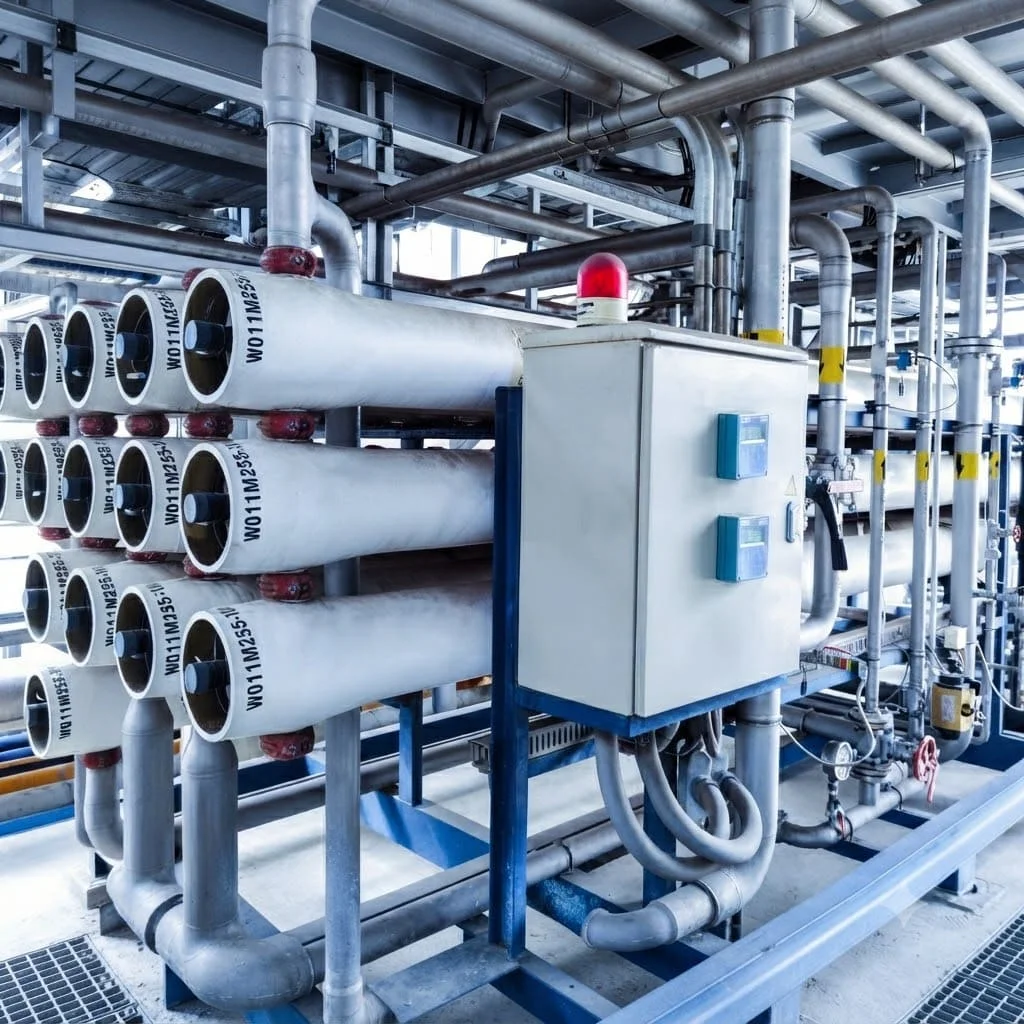


SHREE WATER TECH is a leading Reverse Osmosis Plant Manufacturer, Supplier and Exporter based in Goa. A Reverse Osmosis Plant (RO Plant) is an advanced water purification system that uses semi-permeable membranes to reduce dissolved salts, minerals, contaminants, and other impurities from water. Reverse osmosis is widely used for producing purified water from municipal, borewell, brackish, surface, and industrial water sources.
RO technology works by applying pressure to feed water and forcing it through a specialized membrane. The membrane allows water molecules to pass while restricting many dissolved substances. The resulting streams are known as permeate and concentrate.
Depending on the application, an RO system can be combined with water softening, ultrafiltration (UF), activated carbon filtration, demineralization, disinfection, and post-treatment systems. Learn more about us.
What is a Reverse Osmosis Plant?
A Reverse Osmosis Plant is a water-treatment system designed to separate dissolved contaminants from water using pressure-driven membrane filtration.
In a conventional RO process, feed water is pressurized and supplied to the RO membrane. A portion of the water passes through the membrane as purified permeate, while the remaining stream carries concentrated contaminants away as reject or concentrate.
The main purpose of reverse osmosis is to reduce dissolved substances such as salts and minerals and produce water suitable for drinking, industrial processing, manufacturing, and other applications.
The actual removal performance depends on membrane selection, feed-water chemistry, pressure, temperature, recovery, and pretreatment.
How Does a Reverse Osmosis Plant Work?
As Reverse Osmosis Plant Manufacturers, Suppliers and Exporters based in Goa, an RO Plant we supply generally operates through the following sequence:
1. Feed Water Supply
Raw water is collected from the selected source and transferred to the RO pretreatment section using a suitable feed pump.
2. Pre-Treatment
Pretreatment reduces suspended solids, chlorine, hardness, and other substances that could affect membrane performance. Depending on the source water, this may include Pressure Sand Filter, Activated Carbon Filter, water softener, UF, or chemical dosing.
3. Cartridge Filtration
A cartridge filter provides fine particulate filtration before the high-pressure pump and membrane section. It helps protect the RO membranes from remaining suspended particles.
4. High-Pressure Pumping
The feed water is pressurized to the level required for the selected RO membrane and water chemistry.
5. Membrane Separation
Pressurized water enters the RO membrane assembly. Water passes through the membrane as permeate, while a concentrated stream containing a higher proportion of rejected contaminants leaves as concentrate.
6. Permeate Collection
The purified permeate is collected and transferred to a treated-water tank or post-treatment system.
7. Post-Treatment
Depending on the application, post-treatment can include UV disinfection, ozone, mineralization, pH correction, or additional polishing.
Types of Reverse Osmosis Plants
As leading Reverse Osmosis Plant Manufacturers in Goa, our RO Plant types are designed to meet different application requirements and industry standards, including the following:
- Domestic RO Plant: A Domestic RO Plant is designed for household drinking-water purification. It is selected according to the quality of incoming water, daily consumption, and required treated-water quality.
- Commercial RO Plant: Commercial RO systems are used in offices, hotels, restaurants, schools, hospitals, and other facilities requiring a larger volume of purified water than a household system.
- Industrial RO Plant: An Industrial RO Plant is designed for manufacturing, process-water treatment, boiler applications, pharmaceutical facilities, food processing, and other industrial requirements.
- Municipal RO Plant: Municipal RO systems can be used for larger-scale water purification and treatment projects. The system configuration depends on source-water quality, required production, and applicable water-quality objectives.
- Brackish Water RO Plant: A Brackish Water RO Plant is designed to treat water containing elevated dissolved salts but with characteristics different from seawater. Membrane selection and operating pressure depend on feed-water salinity.
- High-Recovery RO System: A High Recovery RO System is designed to recover a higher proportion of feed water as permeate while reducing concentrate generation. Additional pretreatment or concentrate-management technologies may be required depending on feed-water chemistry.
- Compact and Modular RO Plant: A Compact RO Plant integrates treatment equipment into a space-efficient configuration. A Modular RO Plant can be configured using standardized treatment modules and may support future expansion where the design permits.
- Automatic RO Plant: An Automatic RO Plant uses sensors, control panels, programmable controls, and automated valves to manage operating parameters and system functions with reduced manual intervention.
- Turnkey RO Plant: A Turnkey RO Plant can include system design, equipment supply, installation, piping, electrical work, automation, testing, commissioning, and technical support as part of an integrated project.
Major Components of an RO Plant
A typical RO system supplied by our Goa-based team can include:
- Raw-water tank
- Feed-water pump
- Pressure Sand Filter
- Activated Carbon Filter
- Water softener, where required
- Micron or cartridge filter
- High-pressure pump
- RO membrane housings
- RO membranes
- Flow meters
- Pressure gauges
- Conductivity or TDS monitoring
- Control panel
- PLC automation, where required
- Permeate storage tank
- Post-treatment system
- Concentrate outlet and management system
The final configuration depends on the source-water analysis and intended application.
Technical Specifications of Reverse Osmosis Plant
As a trusted Reverse Osmosis Plant Supplier in Goa, we serve businesses across various industries that meet professional treatment requirements.
| Category | Technical Parameter | Specification | Unit | Typical Value / Range |
|---|---|---|---|---|
| Capacity | Plant Capacity | 250–10,000 | LPH | 250 / 500 / 1,000 / 2,000 / 3,000 / 5,000 / 10,000 |
| Flow | Feed Flow Rate | 0.3–15 | m³/hr | Capacity dependent |
| Recovery | Water Recovery | 50–80 | % | Feed-water quality dependent |
| Feed Water | Feed TDS | 500–10,000 | mg/L | Brackish-water applications |
| Feed Water | Feed Temperature | 15–35 | °C | Design-dependent |
| Electrical | Power Supply | 230 / 415 | V | Single / Three Phase |
| Electrical | Frequency | 50 | Hz | Standard India supply |
| Electrical | Motor Efficiency | IE2 / IE3 / IE4 | — | Motor selection dependent |
| Construction | Skid Material | MS / SS | — | Epoxy-coated MS or SS |
| Installation | Configuration | Skid-Mounted / Modular | — | Compact installation |
| Post-Treatment | UV / Ozone / Dosing | Optional | — | Based on end-use requirement |
| Output | Permeate Quality | Application-specific | TDS / µS/cm | Based on feed and membrane selection |
| Output | Reject Stream | 20–50 | % of feed | Recovery dependent |
| Application | Water Source | Borewell / Municipal / Surface / Process Water | — | Pretreatment varies |
| Application | End Use | Drinking / Process / Boiler / Industrial | — | Customized design |
Features and Benefits of Reverse Osmosis Plant
As Reverse Osmosis Plant Exporters in Goa, our products provide several features and benefits including consistent quality, smooth finish, and long service life.
| Category | Feature | Benefit |
|---|---|---|
| Membrane Technology | Semi-permeable RO membranes | Reduces dissolved contaminants |
| Pretreatment | Multi-stage filtration | Helps protect RO membranes |
| Purification | Pressure-driven separation | Produces purified water |
| Monitoring | Pressure and flow instruments | Supports process control |
| Automation | PLC-based controls | Reduces manual intervention |
| Configuration | Compact and modular options | Provides installation flexibility |
| Water Recovery | Optimized recovery design | Helps improve water utilization |
| Application | Customizable system | Suitable for different water sources |
| Maintenance | Replaceable filtration components | Simplifies servicing |
| Post-Treatment | UV / ozone / mineralization options | Allows final water conditioning |
Applications of Reverse Osmosis Plant
As Reverse Osmosis Plant Manufacturers in Goa, our RO systems are used across various industrial sectors such as:
- Drinking Water Treatment: RO plants are widely used to produce purified drinking water from borewell, groundwater, municipal, and brackish water. They reduce dissolved salts, TDS, and other contaminants to achieve the required water quality.
- Domestic Water Purification: Compact RO systems are used in homes, apartments, and residential facilities where groundwater or other sources require additional purification. They provide treated water for drinking and other household requirements.
- Commercial Water Treatment: Hotels, restaurants, offices, schools, hospitals, and commercial facilities use RO plants for reliable purified-water production. The systems can be configured according to daily consumption and required water quality.
- Industrial Process Water: Industrial RO plants provide treated water for manufacturing and process operations where lower TDS and controlled water quality are required. They are commonly integrated with pretreatment, filtration, softening, or demineralization systems.
- Boiler Feed Water: RO permeate is commonly used as a pretreatment step for boiler feed-water systems to reduce dissolved solids and minimize the ionic load entering downstream treatment. Additional demineralization or polishing may be provided when required by boiler design.
- Pharmaceutical Industry: Pharmaceutical manufacturing requires highly controlled water quality for production and utility operations. RO systems can be integrated with UF, EDI, UV, and other polishing technologies to meet the required process-water specifications.
- Food and Beverage Industry: RO plants are used in food-processing and beverage industries for ingredient water, process water, and utility applications. Controlled TDS and consistent water quality help support product quality and process performance.
- Dairy Industry: Dairy plants use RO technology for treating process water and recovering water from selected wastewater or process streams. The system can be combined with UF and other membrane processes for specialized applications.
- Textile Industry: RO plants are used to produce low-TDS water for textile processing, dyeing, washing, and finishing operations. Treated water can help maintain consistent process conditions and support water-recycling programs.
- Chemical Industry: Chemical manufacturing facilities use RO systems where reduced dissolved solids are required for process or utility water. RO can also be incorporated into broader water-treatment trains with filtration and demineralization.
- Power and Utility Plants: RO is commonly used as a pretreatment stage for demineralized water and boiler-feed-water systems in power and utility applications. It helps reduce the dissolved ionic load before downstream polishing equipment.
Reverse Osmosis Plant Capacity
RO Plant capacity is commonly expressed in LPH (Litres Per Hour). The appropriate capacity depends on water consumption, required production, operating hours, feed-water availability, and recovery requirements.
Common system capacities include:
| Capacity | Nominal Production Rate |
|---|---|
| 50 LPH | 50 litres/hour |
| 100 LPH | 100 litres/hour |
| 250 LPH | 250 litres/hour |
| 500 LPH | 500 litres/hour |
| 1,000 LPH | 1,000 litres/hour |
| 2,000 LPH | 2,000 litres/hour |
| 3,000 LPH | 3,000 litres/hour |
For larger applications, industrial and municipal RO systems above 2,000 LPH can be engineered according to project requirements.
Actual permeate production depends on feed-water temperature, pressure, salinity, membrane condition, recovery rate, and pretreatment quality.
Factors to Consider When Selecting an RO Plant
The first consideration should be a detailed feed-water analysis. Important parameters include TDS, hardness, turbidity, pH, temperature, silica, iron, manganese, alkalinity, chlorine, and microbiological characteristics where applicable.
Other factors include required permeate quality, daily water demand, peak consumption, recovery target, available space, power supply, pretreatment requirements, membrane selection, concentrate management, automation level, and future expansion.
Selecting the system solely by nominal capacity can result in improper sizing if feed-water chemistry is not considered.
Reverse Osmosis Plant Cost
The cost of an RO Plant depends on its capacity, membrane configuration, feed-water quality, pretreatment requirements, automation, construction material, recovery target, and installation scope.
A domestic system has a different cost structure from a commercial or industrial RO plant because industrial systems require larger pumps, membrane assemblies, and pretreatment equipment, instrumentation, and control systems.
The overall project cost may include pretreatment equipment, pumps, membranes, membrane housings, filters, electrical panels, instrumentation, piping, storage tanks, installation, commissioning, and post-treatment equipment.
Operating costs should also account for electricity, filter replacements, membrane cleaning, chemicals, membrane replacement, and concentrate management.
RO Plant Installation & Maintenance
RO installation begins with site assessment and equipment positioning. Feed-water and product-water connections are established along with concentrate discharge or recovery arrangements.
Electrical connections, control panels, pumps, instruments, and automated valves are then commissioned and tested.
Routine maintenance includes:
- Replacing cartridge filters
- Monitoring inlet and outlet pressure
- Checking permeate flow
- Monitoring product-water TDS or conductivity
- Inspecting pumps
- Cleaning membranes when required
- Checking pretreatment equipment
- Inspecting valves and piping
- Calibrating instruments
- Monitoring recovery performance
Consistent pretreatment and timely membrane cleaning can help maintain stable RO performance.
Why Choose Us?
As high-quality Reverse Osmosis Plant Manufacturers, Suppliers and Exporters based in Goa, we stand out by delivering premium solutions. Here's why:
- Optimized Pretreatment: Suitable pretreatment can be incorporated to protect RO membranes from suspended solids, hardness, chlorine, iron, and other fouling contaminants. This helps improve membrane performance, operating stability, and service life.
- High-Quality RO Membrane Systems: We select suitable RO membranes and membrane configurations according to TDS, salinity, recovery requirements, and permeate-quality targets. The system can be designed for brackish water, process water, or other specialized applications.
- Smart Automation & Monitoring: RO plants can be equipped with automatic controls, PLC systems, pressure monitoring, flow measurement, conductivity monitoring, and safety interlocks. These features help operators monitor plant performance and manage routine operation efficiently.
- Water Recovery Solutions: Our systems can be engineered with suitable recovery arrangements to maximize usable water while managing the reject stream effectively. Advanced configurations can be integrated with water recycling and reuse systems where required.
- Complete Project Support: We provide support from process selection and system design to manufacturing, installation, commissioning, automation, and technical assistance. This provides customers with a coordinated solution throughout the project lifecycle.
Choose Shree Water Tech, a well-known Reverse Osmosis Plant Manufacturer, Supplier and Exporter based in Goa. A Reverse Osmosis Plant provides an effective membrane-based approach for reducing dissolved salts and other contaminants from water. Its performance depends on appropriate membrane selection, adequate pretreatment, correct operating conditions, and regular maintenance. RO technology can be configured for domestic, commercial, industrial, and municipal applications, with additional technologies incorporated when specific water-quality or recovery objectives must be achieved. Contact us today for a customized RO Plant solution, water analysis assessment, technical consultation, and project quotation.
FAQ's
Reverse Osmosis Plants are water-treatment systems that use semi-permeable membranes and applied pressure to separate water from many dissolved salts, minerals, and other contaminants.
The main purpose of RO is to reduce dissolved substances from water and produce a purified permeate stream suitable for the intended application.
RO systems can broadly be categorized according to application and feed-water characteristics, such as domestic RO, commercial RO, brackish-water RO, and industrial RO systems.
RO Plants are used for drinking-water purification, process-water treatment, industrial water production, desalination-related applications, and water-recovery systems.
RO provides very fine membrane separation and is widely used for dissolved-salt reduction. UF primarily removes suspended solids, colloids, and larger molecular contaminants, while NF provides intermediate separation and can reduce selected dissolved components.